

Key Takeaways
Following Distance
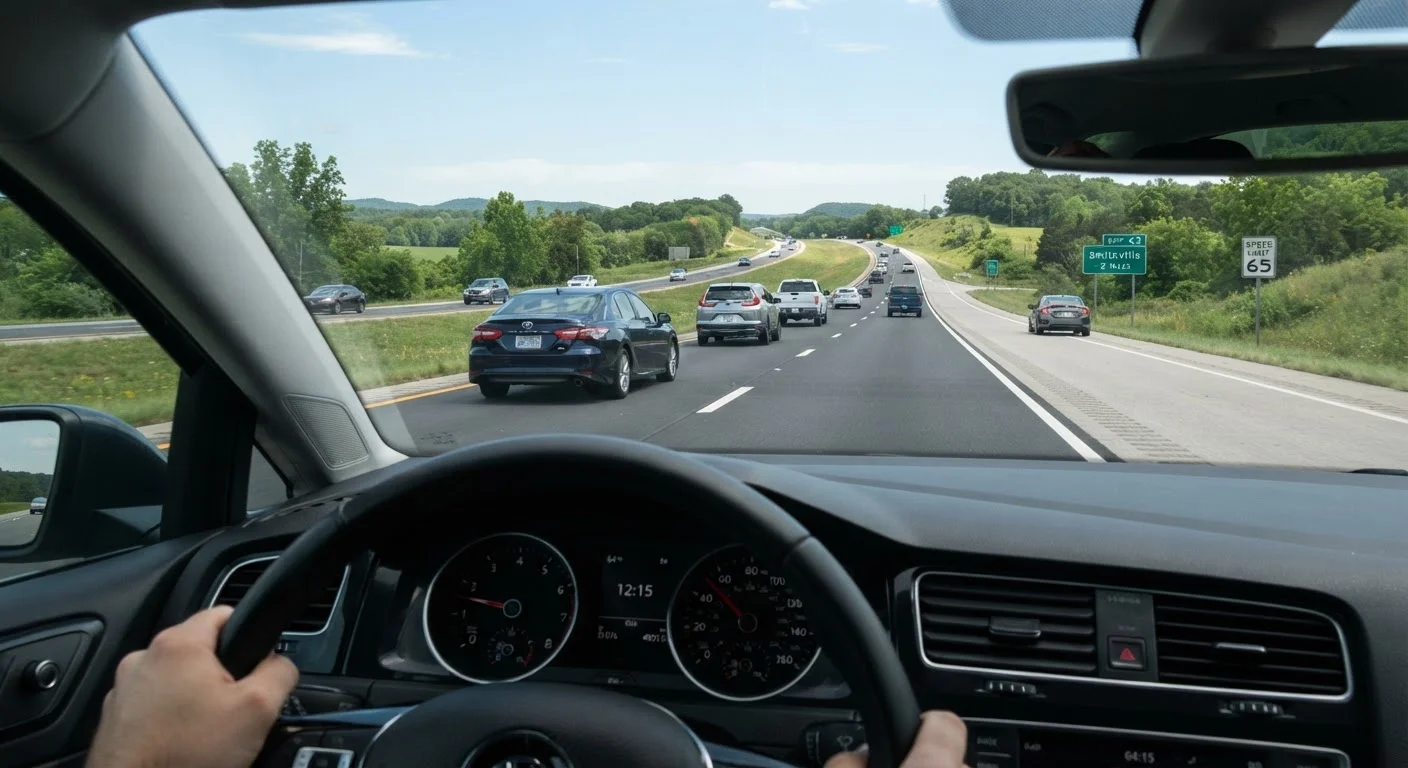
Following distance is the gap between your vehicle and the one directly ahead of you. It represents the space and time you have to react and stop before a collision if the lead vehicle brakes suddenly. Most driving experts recommend measuring this gap in seconds rather than car lengths, because seconds scale with your speed automatically.
The 'two-second rule' is a minimum baseline recommended under normal conditions. Wet roads, reduced visibility, heavier vehicles, and impaired reaction time all call for extending that gap to three or four seconds or more.
Why the Gap in Front of You Is a Time Budget, Not Just Space
Most drivers think of following distance in terms of car lengths — a rough, visual estimate that feels intuitive but doesn't actually scale with speed. Driving safety researchers have long recommended thinking in seconds instead, because time is the true resource you're managing between you and a collision.
Here's the core problem: when the car ahead of you brakes suddenly, your foot doesn't hit the pedal instantly. Research on human reaction time consistently places the average driver's response at roughly 1.5 seconds from perceiving a hazard to applying the brakes. At 60 mph, your car travels about 132 feet in that time — before any actual braking occurs. Then comes the physical stopping distance itself, which adds more. The two-second rule exists because it provides a minimum buffer that accounts for both reaction and braking under normal conditions.
The math shifts dramatically with speed. At 30 mph, stopping takes roughly 75 feet total. At 60 mph — double the speed — stopping distance can exceed 300 feet. That's not a linear relationship. It's closer to exponential, because kinetic energy increases with the square of velocity. This is why speed decisions carry disproportionate consequences that most drivers underappreciate.
1.5 sec
Average driver reaction time before braking
Traffic safety researchers consistently cite 1.5 seconds as a typical perception-reaction time, meaning your car travels significantly before brakes engage.
~300 ft
Total stopping distance at 60 mph
On dry pavement with adequate brakes, stopping from 60 mph typically requires around 300 feet when reaction time and braking distance are combined.
2x
Braking distance increase on wet roads
Wet pavement can roughly double the distance required to stop compared to dry conditions, according to general traffic engineering guidance.
29%
Share of crashes involving rear-end collisions
NHTSA crash data has consistently shown rear-end collisions represent roughly a quarter to a third of all reported crashes on U.S. roads.
What the Research Says About Rear-End Crashes
Rear-end collisions are a persistent and largely preventable problem on American roads. The National Highway Traffic Safety Administration (NHTSA) has consistently identified them as one of the most common crash types, accounting for a substantial share of both injury crashes and fatalities annually. The primary contributing factors show up repeatedly: insufficient following distance and driver inattention.
Distraction compounds the following-distance problem in a specific way. When a driver's eyes leave the road — even for two seconds — they've effectively eliminated any gap they were maintaining. A car traveling at highway speed covers the length of a football field in about three seconds. Cognitive distraction reduces hazard detection even when a driver's eyes appear to be forward, making adequate following distance even more essential as a backup buffer.
For newer drivers, these risks are compounded. Inexperience means slower hazard recognition and less-practiced braking judgment. Teen drivers face elevated crash risk partly because they haven't yet developed the automatic distance calibration that experienced drivers build over years of feedback.
“Most drivers think they're paying attention when they're actually operating on autopilot. The gap you keep isn't just about stopping — it's about having time to think.”
— A traffic safety researcher, Contributor to driver behavior and crash prevention literature
Where the Two-Second Rule Falls Short
The two-second rule is a useful, teachable baseline — but it's important to understand its limits. It was designed for dry roads, alert drivers, and vehicles in good mechanical condition. Real driving rarely checks all those boxes simultaneously.
On wet pavement, braking distance can roughly double. On ice, it can multiply several times over. Towing a trailer, driving a loaded truck, or following a vehicle much larger than yours all change the stopping equation. Fatigue slows reaction time significantly — a drowsy driver can respond as slowly as an impaired one. In any of these situations, two seconds of gap is likely insufficient.
Tailgating removes what little buffer exists and dramatically increases crash severity when contact does occur. Part of defensive driving means treating the two-second rule as a floor, not a ceiling, and adjusting upward based on conditions rather than defaulting to the minimum.
A practical approach: on the highway in clear weather, aim for three seconds. In rain, four. On rural roads with deer or limited visibility, more. If you're ever unsure whether you have enough distance, you probably don't — the default should be more space, not less.
Building the Habit: Why Drivers Consistently Underestimate the Gap They Need
If the two-second rule is simple and well-known, why do so many drivers ignore it? Part of the answer is perceptual. Humans are not naturally good at estimating speed or distance while moving. Studies in traffic psychology suggest drivers routinely overestimate their reaction speed and underestimate how far they travel during that window.
There's also a social dimension. Heavy traffic creates a norm of close following. When everyone around you is tailgating, maintaining proper distance can feel like an invitation for others to merge into your gap — which, paradoxically, is exactly what should happen. Vehicles merging into your following distance are not taking something from you; the gap regenerates as you ease back slightly.
Building this habit takes conscious practice. One approach: use fixed roadside markers — signs, poles, overpasses — to actually count off two or three seconds after the vehicle ahead passes. Doing this periodically recalibrates your sense of what the right distance actually looks like. Most drivers who try it discover they've been following too closely for years without realizing it.
For a broader picture of how distance fits into overall road safety habits, see our complete overview of safe driving in America.