

Key Takeaways
Driver Distraction
Driver distraction is anything that pulls a driver's attention away from the primary task of safely operating a vehicle. It covers three distinct categories: visual (eyes off the road), manual (hands off the wheel), and cognitive (mind off the task). Many activities — texting being the most cited — trigger all three at once.
Cognitive distraction is the least visible and most underestimated type; research from the AAA Foundation for Traffic Safety has measured it using brain-imaging and reaction-time studies that show hands-free phone conversations still impair driving performance significantly.
The Three Types of Distraction — and Why They're Not Equal
Traffic safety researchers break driver distraction into three categories, each targeting a different part of what driving actually requires.
- Visual distraction — your eyes leave the road. Glancing at a GPS display, checking a mirror longer than necessary, or watching a roadside scene all qualify.
- Manual distraction — your hands leave the wheel. Eating, adjusting the radio, or reaching for something in the back seat are common examples.
- Cognitive distraction — your mind leaves the task of driving, even if your eyes are technically forward. A heated phone conversation, daydreaming, or processing emotional news all fall here.
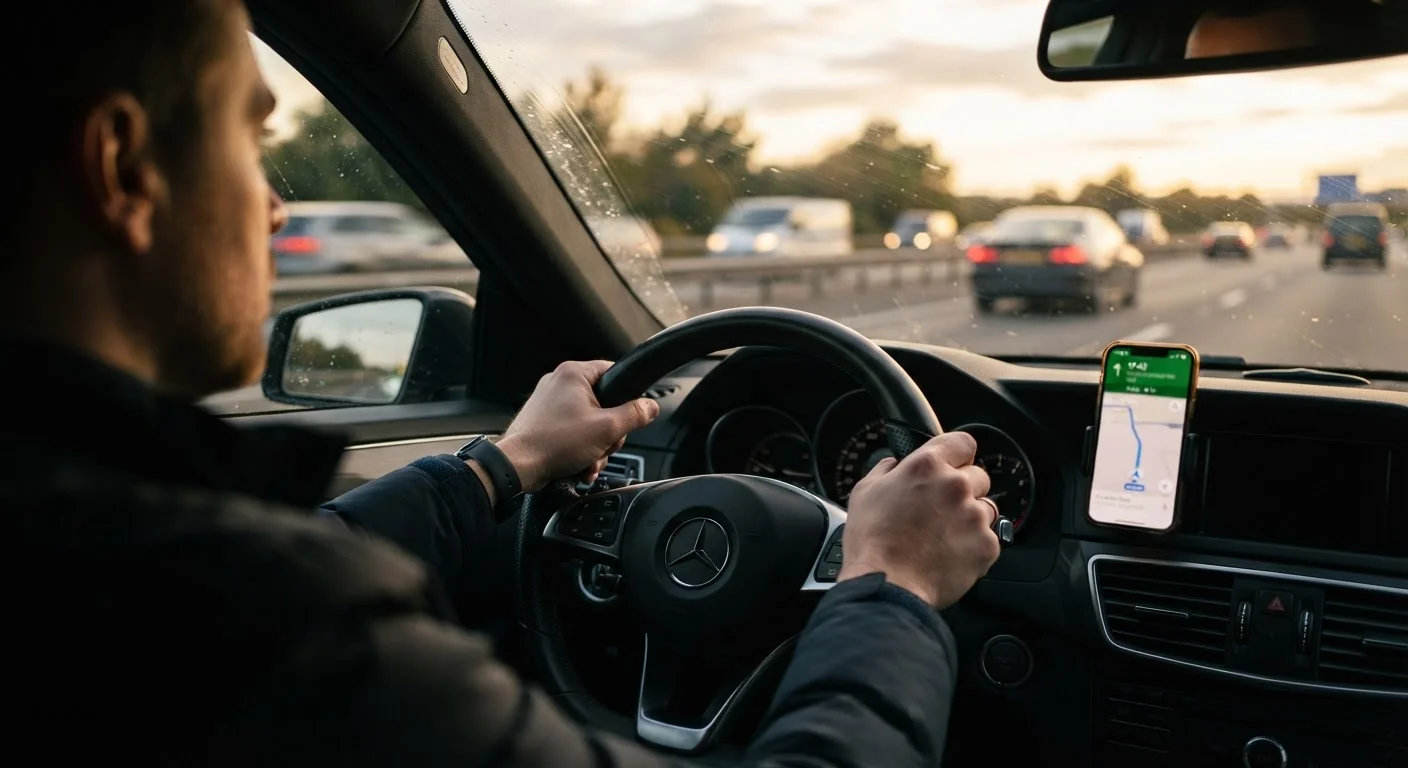
The reason these distinctions matter is that the interventions for each type differ. Mounting your phone so you can glance at navigation addresses visual distraction. Finishing your coffee before you leave addresses manual distraction. But cognitive distraction is harder to manage — and far easier to underestimate.
Cognitive Distraction Is Hard to Self-Assess
Most drivers overestimate their ability to detect when they are cognitively impaired. Because cognitive distraction does not feel physically different from normal attentiveness, people often believe they are performing well when reaction-time data says otherwise. This is sometimes called the "illusion of safety" with hands-free devices.
Why the Brain Can't Actually Multitask at Speed
The idea that humans can truly multitask is a myth that cognitive science has consistently challenged. What the brain actually does is task-switch — moving attention rapidly between competing inputs. Under low-demand conditions, this can feel seamless. On a road moving at 70 mph, it is not.
Driving is a high-bandwidth task that pulls from the same cognitive resources as conversation, problem-solving, and emotional processing. When those resources are shared, performance on every task degrades. Reaction times slow. Peripheral hazards are missed. Decisions are made on less information.
This is why following distance matters so much — a distracted driver's reaction time extends measurably, shrinking the window between seeing a hazard and responding to it. For more on how shared attention affects different road environments, see our piece on how risk profiles differ between highway and city driving.
~9
People killed daily in distraction-related crashes
According to the National Highway Traffic Safety Administration (NHTSA), distracted driving claimed approximately 3,300 lives in a recent reporting year, averaging roughly nine fatalities per day.
~100 yards
Distance traveled during a 5-second phone glance at 55 mph
This estimate, widely cited by NHTSA and traffic safety educators, equates to traveling the length of an American football field without full visual attention on the road.
4x
Crash risk increase from handheld phone use
Research referenced by the National Safety Council suggests that talking on a handheld cell phone while driving quadruples crash risk compared to undistracted driving.
Texting: Why It's the Worst-Case Combination
Texting while driving is widely cited as one of the most dangerous distracted-driving behaviors because it triggers all three distraction types simultaneously. Your eyes drop to the screen (visual), your hands shift to the phone (manual), and your mind engages with composing or reading a message (cognitive). That convergence makes it uniquely hazardous compared to adjusting the heat or changing a radio station, each of which typically involves only one or two distraction types.
The five-second benchmark matters here: looking away from the road for roughly five seconds at 55 mph means traveling about 100 yards without full visual attention — enough distance for multiple traffic events to develop and escalate. The same cognitive load that makes texting dangerous at a desk also degrades performance in other high-stakes contexts.
It is also worth noting that voice-to-text features do not fully solve the problem. Composing a message by voice still engages cognitive resources and may cause drivers to believe they are safer than they actually are.
What Doesn't Count — and What's Closer Than You Think
Not every act of divided attention is equally risky. Checking your mirrors, adjusting your grip, or briefly scanning a clear intersection are all normal parts of driving — they are built into the skill itself. The line between routine driving behavior and distraction is whether the secondary activity is necessary to the driving task and whether it pulls attention at a moment when the road demands full focus.
A few commonly misclassified situations:
- Talking to a passenger — this is a mild cognitive distraction, but research suggests passengers self-regulate; they tend to go quiet when traffic gets complicated. A phone caller cannot see the road and does not adjust.
- Music and podcasts — audio-only content at reasonable volume creates minimal distraction for most drivers, though content that provokes strong emotional responses can creep into cognitive distraction territory.
- Eating or drinking — these are manual and sometimes visual distractions. A spill or a wrapper fumble at the wrong moment carries real risk, particularly in city traffic where conditions change quickly.
The pattern that connects the riskiest behaviors is the same one that compounds fatigue-related impairment: overconfidence in one's own capacity to handle more than the road actually allows.
Make the Safer Choice the Default
Rather than relying on in-the-moment decisions, set a habit before you start the car: silence your phone, queue your navigation, and stow anything you might reach for. Reducing the temptation at the source is far more reliable than resisting it at 60 mph.
Practical Steps That Actually Reduce Distraction
Awareness is a start, but behavior change requires friction-reducing strategies — making the safer choice the easier one.
- Put the phone out of reach before moving. The back seat or glove box works better than willpower. Many smartphones include a driving mode that silences notifications automatically.
- Set navigation before you drive. Entering a destination while in motion is both a visual and manual distraction. Even a brief GPS interaction on a busy road is higher-risk than it appears.
- Keep eating and grooming off the pre-drive checklist. These feel minor but regularly require hands off the wheel at unpredictable moments.
- Use voice controls judiciously. Hands-free systems reduce manual distraction, but voice commands still draw cognitive load. Keep interactions brief and avoid complex tasks while moving in traffic.
Distraction is one of the most controllable risk factors in everyday driving. Unlike poor weather or another driver's behavior, what you do inside your vehicle is entirely within your decision. Stopping distance data shows just how little margin exists once attention lapses — making pre-trip habits one of the highest-return safety investments a driver can make.