

Key Takeaways
Tailgating
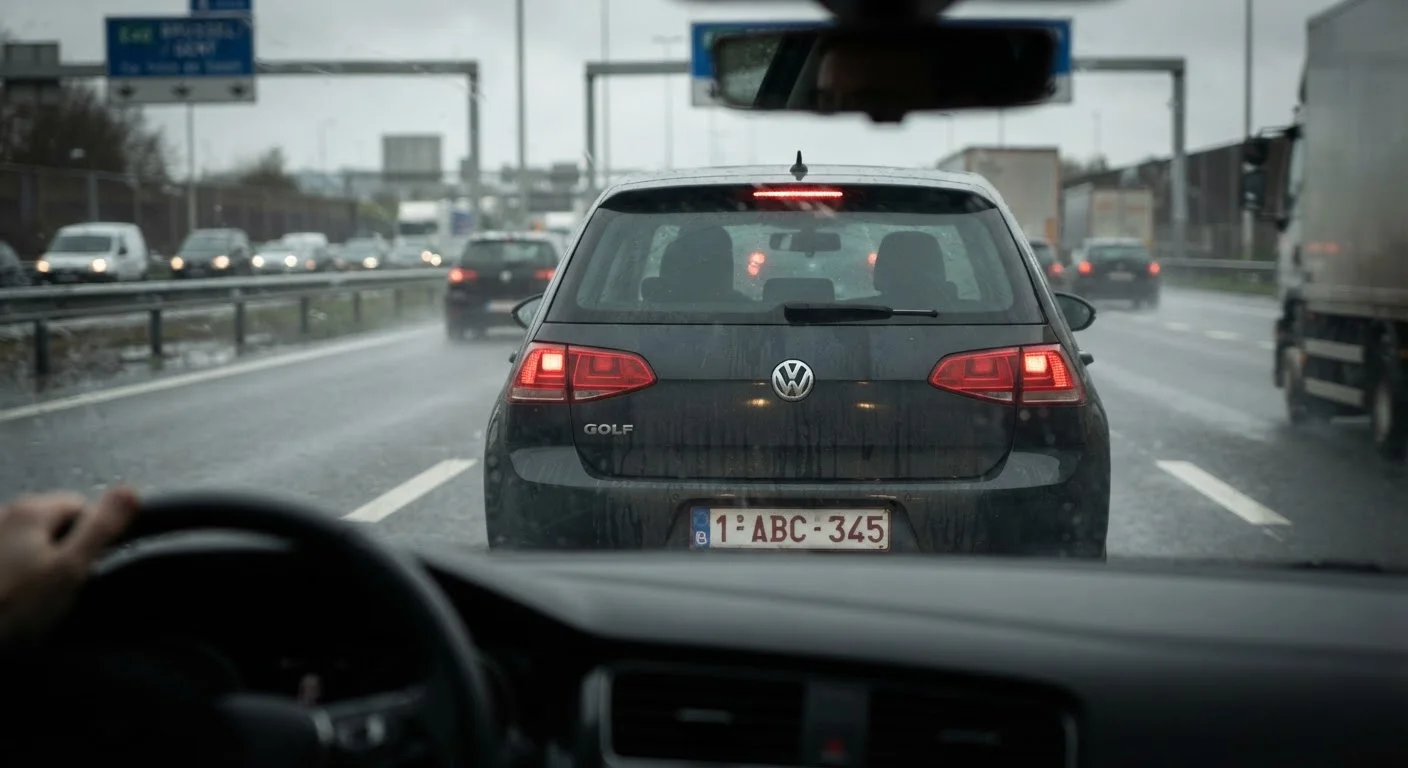
Tailgating means following another vehicle so closely that you don't have enough room to stop safely if the car ahead brakes suddenly. The term covers any situation where the gap between your front bumper and the vehicle ahead is shorter than your total stopping distance at your current speed. It's one of the leading causes of rear-end collisions on American roads.
Total stopping distance combines reaction distance (how far the car travels while the driver processes a hazard and presses the brake) and braking distance (how far the car travels after braking begins). Both increase with speed, making the math more punishing the faster you go.
The Numbers Behind Stopping Distance
Stopping a car isn't instant — it's a two-step process that most drivers underestimate. First comes reaction distance: the ground covered while your brain registers the threat and your foot moves to the brake. At an average reaction time of 1.5 seconds, a car traveling 60 mph covers roughly 132 feet before braking even begins. Then comes braking distance — the additional 180-plus feet needed to come to a full stop under normal conditions. Add those together and you're looking at over 300 feet of total stopping distance at 60 mph.
Here's how that plays out at common speeds:
- 30 mph: ~75 feet reaction + ~45 feet braking = ~120 feet total
- 45 mph: ~100 feet reaction + ~100 feet braking = ~200 feet total
- 60 mph: ~132 feet reaction + ~180 feet braking = ~310+ feet total
- 70 mph: ~154 feet reaction + ~245 feet braking = ~400 feet total
Wet pavement, worn tires, or slow reaction due to distraction push all of these numbers higher. A tailgating driver leaving one car length — roughly 15 feet — at 60 mph is working with about 4% of the space they actually need.
29%
Of all U.S. traffic crashes are rear-end collisions
According to federal highway safety data, rear-end crashes represent nearly one in three reported traffic collisions nationally.
300+ ft
Total stopping distance at 60 mph
Under normal road and tire conditions, a vehicle traveling 60 mph needs over 300 feet to come to a complete stop from the moment a hazard is perceived.
1.5 sec
Average driver reaction time before braking
At 60 mph, 1.5 seconds of reaction time means a car travels approximately 132 feet before the brakes even engage.
Why Drivers Tailgate Anyway
Understanding the behavior matters as much as understanding the physics. Tailgating is rarely random — it tends to come from a handful of predictable triggers.
Frustration and aggression. When drivers feel another vehicle is moving too slowly or blocking their progress, following closely is a common — if counterproductive — response. This is a form of aggressive driving, and it tends to cloud judgment about actual risk.
Time pressure. Drivers running late often unconsciously close the gap, as if proximity to the car ahead will somehow speed things up. In reality, the time saved by tailgating on a typical commute is negligible — a few seconds at most — while the risk increase is substantial.
Overconfidence in reaction speed. Many drivers believe they can stop faster than physics actually allows. Studies on driver self-assessment consistently show that most people rate their own reaction time and skill as above average — a statistical impossibility that translates directly to unsafe following distances.
Highway hypnosis and inattention. On long, monotonous stretches, drivers gradually drift closer to the vehicle ahead without realizing it. This is a passive form of tailgating, but the physics are identical to the aggressive kind.
“Drivers consistently overestimate their ability to stop quickly and underestimate how much distance they actually need. The gap between perceived safety and physics is where most rear-end crashes happen.”
— National Highway Traffic Safety Administration, U.S. federal agency responsible for road safety research and standards
For a broader look at how speed myths compound these risks, see how common speed misconceptions increase crash risk.
What Tailgating Actually Costs in a Crash
Rear-end collisions account for approximately 29% of all reported traffic crashes in the United States, according to federal highway safety data. The overwhelming majority involve a following vehicle that simply ran out of stopping distance.
The consequences go beyond fender benders. Even a relatively low-speed rear-end crash can cause whiplash injuries, airbag deployment, and totaled vehicles. At highway speeds, rear-end collisions frequently trigger multi-car pileups, particularly in congested traffic or low-visibility conditions like fog.
Financially, being the at-fault driver in a rear-end crash generally means your insurance covers the other driver's repairs and medical costs — and your own premiums increase accordingly. In serious injury cases, civil liability can extend well beyond insurance policy limits.
If you regularly share roads with large trucks, the stakes are even higher. A passenger vehicle following a semi-truck too closely loses the ability to see what's ahead and loses critical braking time. What passenger vehicle drivers need to know about sharing roads with large trucks covers this in more depth.
Practical Ways to Stop Tailgating
Changing a habitual behavior takes deliberate effort, but the three-second rule gives drivers something concrete to practice.
The three-second rule: Pick a fixed object — a sign, a bridge, a lane marker. When the car ahead passes it, count slowly to three. If you reach that same object before finishing your count, you're too close. This method scales with speed automatically because you're measuring time, not distance.
Make the Three-Second Rule a Habit
The next time you're on a highway, actively count your following gap using roadside markers every few minutes. Most drivers discover they're following closer than they realized. Regular self-checks build the habit until adequate spacing becomes automatic.
Beyond the rule itself, a few habits reinforce safer following distance:
- Anticipate, don't just react. Scan beyond the car immediately ahead. If traffic is slowing two cars up, you can begin easing off the accelerator before the car directly in front brakes.
- Adjust for conditions. Rain, night driving, heavy loads, and road construction all extend stopping distances. How darkness changes stopping and reaction time at night explains why visibility loss compounds this problem after dark.
- Let tailgaters pass. If someone is following you closely, safely move over where possible. Matching their aggression by braking sharply is dangerous and can escalate the situation.
For a deeper dive into the research on reaction time and following distance, the science behind following distance and why most drivers get it wrong is worth reading alongside this article.