

Key Takeaways
Our Verdict
Passenger cars and large trucks operate under fundamentally different physical rules, and the burden of awareness falls more heavily on car drivers simply because the consequences of a collision are far more severe for the smaller vehicle. Understanding truck blind spots, braking limits, and turning behavior turns passive road sharing into an active, manageable safety practice.
| Best for | Recommended |
|---|---|
| Drivers who regularly travel interstate highways alongside commercial traffic | Maintain a 4-second following gap and pass decisively — never linger beside a truck |
| Urban and suburban drivers encountering trucks at intersections | Hang back and give turning trucks full lane space — never pull up alongside |
| New or less experienced drivers building highway confidence | Study truck blind spot zones before driving and practice the 'see the mirror' visibility rule |
Why the Physics Work Against You
A fully loaded tractor-trailer can weigh up to 80,000 pounds — roughly 20 to 30 times the weight of an average passenger car. That mass gap isn't just a stat; it reshapes every interaction between the two vehicles. In a collision, the laws of physics favor the heavier object, and the occupants of the lighter one absorb a vastly disproportionate share of the force.
Stopping distance is the most immediate practical consequence. At 65 mph, a passenger car in good condition typically needs around 300 feet to stop. A fully loaded commercial truck needs 400 feet or more under the same conditions — and that assumes well-maintained brakes. Wet roads, worn tires, or a heavy load can extend that further. This means a truck driver who sees a hazard at the same moment you do will still be traveling at speed long after your car has stopped.
For a broader look at how road type affects these risks, see our article on highway versus city driving risk profiles.
80,000 lbs
Maximum legal weight for U.S. semi-trucks
Per federal regulations, fully loaded tractor-trailers can reach this weight, roughly 20–30 times that of a typical passenger car.
~40%
Extra stopping distance for loaded trucks vs. cars
At highway speeds, a loaded commercial truck typically requires significantly more distance to stop than a passenger car under the same conditions.
4 seconds
Recommended minimum following gap behind trucks
Safety experts generally recommend at least double the standard two-second rule when following large commercial vehicles.
The Four Blind Spot Zones Every Car Driver Should Know
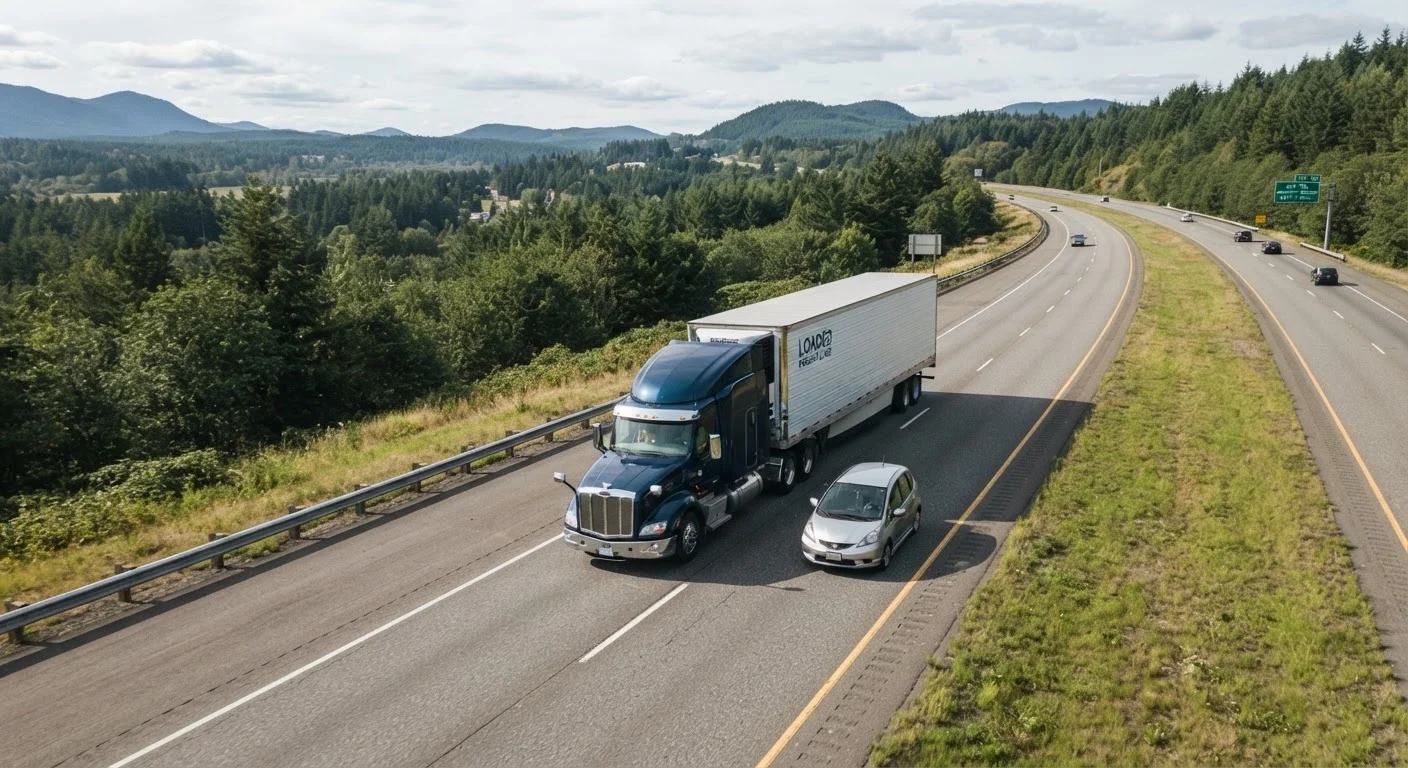
Commercial trucks don't have rear windows. Truck drivers rely entirely on side mirrors, which leave substantial visibility gaps. The Federal Motor Carrier Safety Administration (FMCSA) identifies four primary no-zones around large trucks:
- Directly behind the trailer: Extending roughly 30 feet back. The truck driver cannot see you at all here.
- Directly in front of the cab: Approximately 20 feet forward. If you cut in too close after passing, you vanish from the driver's view.
- The right side: This is the largest blind spot — it extends across multiple lanes diagonally back from the cab. Never travel alongside the right side of a truck for any extended period.
- The left side: A smaller but real blind spot running from the cab back about half the length of the trailer.
A useful rule of thumb: if you can't see the truck driver's face in their side mirror, they cannot see you. Our article on blind spots and mirror coverage explains how this visibility gap affects all vehicle types.
Use the Mirror Test Before Committing to a Lane
Before settling in beside or behind a large truck, check whether you can see the driver's face in their side mirror. If you can't, you're in a blind spot and the driver has no idea you're there. Adjust your position — forward, back, or over — until you reestablish that mirror-to-face sightline. This quick check takes seconds and dramatically changes your risk exposure.
Passing and Following: The Rules That Actually Reduce Risk
Passing a large truck safely requires a different approach than passing another car. Here's what matters:
- Pass on the left. The driver's blind spot is significantly smaller on the left side than the right.
- Pass decisively. Lingering alongside a truck — especially near its rear axles — puts you in a zone where a tire blowout, a lane shift, or wind turbulence can cause a crash with almost no warning time.
- Don't cut back in too soon. After passing, wait until you can see the full front of the truck in your rearview mirror before merging back. Cutting in short puts you directly in the truck's forward blind spot and leaves no buffer if the truck needs to brake.
Following distance is equally critical. The standard two-second rule that applies between two cars isn't adequate behind a large truck. Aim for at least four seconds of following distance — more in bad weather or on grades. Tailgating a truck is particularly dangerous because the trailer can block your view of the road ahead entirely. Our piece on tailgating and stopping distances breaks down exactly what that gap means at different speeds.
Wide Turns, Intersections, and the Squeeze Risk
Large trucks routinely swing wide to the left before turning right — this is by design, not error. The rear axles of a long trailer track inside the path of the front wheels, and without that wide setup, the trailer would jump curbs or clip obstacles. The danger for car drivers is misreading that leftward swing as an opening to pass on the right.
Never move up alongside a truck that is preparing to turn. If you're at a red light and a truck is in the right lane signaling right, stay behind it. Don't pull up to its right side. The space will close as the trailer swings through the turn, and passenger cars caught in that gap have no room to escape.
At four-way stops and uncontrolled intersections, give trucks extra time and space to clear. They may need multiple signal cycles or a wider setup than their lane suggests. Our guide on intersection right-of-way rules covers how these situations should legally unfold.
Putting It Into Consistent Practice
Most of what makes truck interactions safer comes down to two behaviors: staying visible and being predictable. Trucks can't respond to sudden moves the way a car can. Lane changes that seem routine in light traffic become high-stakes maneuvers near a commercial vehicle.
The habits that help most are straightforward: give trucks extra space before and behind, pass on the left and do it cleanly, don't linger in blind spots, and never assume a truck driver can see you just because you can see the truck. These aren't complicated rules — they're consistent practices that reduce exposure to a situation where the physical odds are not in a passenger car's favor.
For a broader framework of driving habits that hold up across all road conditions, see building safer habits in everyday driving. And for a comprehensive look at road safety in the U.S., our complete safe driving overview is a useful reference.