

Key Takeaways
Vehicle Blind Spot
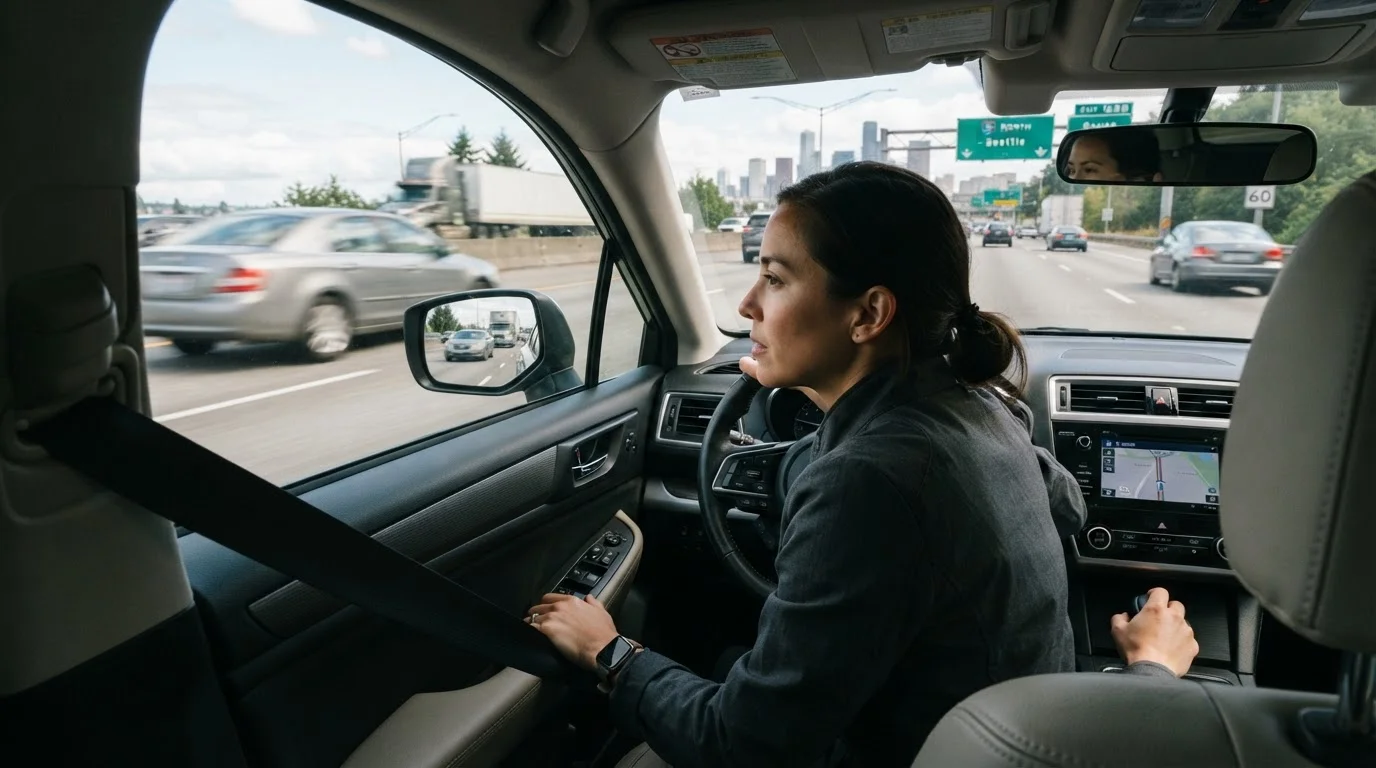
A blind spot is any area around your vehicle that you cannot see through your mirrors or with normal forward vision. Every car has them — some larger than others. They are most dangerous during lane changes, merges, and backing maneuvers when other road users can be completely hidden from your view.
Blind spot size is affected by vehicle design, pillar thickness (the A-, B-, and C-pillars framing your windows), mirror size and adjustment, and the driver's seating position relative to the windows.
Why Mirrors Alone Leave Gaps
Most drivers trust their mirrors as their primary source of rearward awareness — and mirrors do a lot of work. But mirrors reflect a fixed angle, and the geometry of a car guarantees that certain zones behind and alongside your vehicle simply won't appear in any of them.
The standard mirror setup — rearview mirror plus two side mirrors — is designed to give overlapping coverage behind the vehicle. The problem is that coverage has edges, and those edges correspond exactly to where another car, a cyclist, or a motorcyclist can travel without appearing in any mirror. This is why drivers who check mirrors faithfully can still be surprised during a lane change.
The size of your blind spots also depends on how your mirrors are adjusted. Most drivers angle their side mirrors too far inward, showing themselves a reassuring view of their own car's flanks. Correcting that outward — to where the mirror barely loses sight of your vehicle's side — meaningfully extends your lateral view. It won't close the gap entirely, but it helps.
Night Driving Compounds Blind Spot Risk
At night, the visual cues you use to detect vehicles approaching your blind zone — movement, color contrast, shadows — are significantly reduced. A vehicle without functioning lights may be nearly invisible in your blind spot until it's very close. Our article on night driving risks and strategies covers how darkness changes the overall challenge of road awareness.
For a broader look at how visibility and other factors combine to create freeway risk, see our piece on merging and lane-change crashes.
Where Blind Spots Form on a Typical Vehicle
On most passenger cars, the critical blind spots fall into a few predictable locations:
- Rear corners: The zones just behind each rear quarter panel — roughly where another vehicle sits when it's pulled alongside you but not quite passed — are the most dangerous. These are the gaps a lane change can close in a second.
- A-pillar zones: The angled posts framing your windshield (called A-pillars) can hide a pedestrian, cyclist, or even a slow-moving car at intersections and crosswalks, particularly when turning.
- Direct rear center: In vehicles without a rearview camera, the area immediately behind the bumper — especially low and close — is nearly invisible from the driver's seat.
Vehicle design matters here. Thick pillars, small rear windows, high trunk lines, and headrest placement all influence how much of the surrounding road is actually visible to the driver.
~840,000
Annual U.S. blind spot crashes estimated
The National Highway Traffic Safety Administration (NHTSA) has estimated that hundreds of thousands of crashes annually involve blind spot-related factors, particularly during lane changes.
4
Major blind zones on a typical semi-truck
The Federal Motor Carrier Safety Administration identifies four primary no-zone areas around large commercial trucks where passenger vehicles disappear from the driver's view.
2018
Year backup cameras became federally required
A federal rule took effect requiring all new passenger vehicles sold in the U.S. to include a rear-view camera system, addressing the rear blind zone that mirrors cannot cover.
Large Trucks: A Different Scale of Blind Zone
If blind spots on a passenger car are a concern, on a commercial semi-truck they're a serious road-sharing reality. Large trucks have four distinct blind zones that dwarf what most drivers imagine.
The right side of a truck — spanning the full length of the trailer and extending multiple lanes wide — is the largest. The left side has a blind zone as well, though narrower. Directly in front of the cab, the driver's elevated seat height creates a zone that can hide a car or cyclist stopped too close to the front bumper. And directly behind the trailer, there's no mirror view at all for a significant distance.
The practical guidance that applies here: if you can't see a truck driver's face in their mirror, they almost certainly cannot see you. Passing quickly and completely — rather than lingering alongside — reduces the time you spend in a truck's blind zone. For a more detailed look at this dynamic, see our overview of sharing the road with large trucks.
Practical Habits That Reduce Blind Spot Risk
Technology has improved the picture — blind spot monitoring systems, backup cameras, and 360-degree camera setups are increasingly common. But good habits remain the most reliable safety layer, and they cost nothing.
Build the Shoulder Check Into Every Lane Change
Before changing lanes, check your mirror, signal, check your mirror again — then do a quick glance over your shoulder toward the rear quarter window on the side you're moving toward. This sequence takes about two seconds and is one of the most effective ways to catch what mirrors cannot show. Make it a habit, not an occasional precaution.
- Shoulder check before every lane change: A quick glance over your shoulder toward the rear quarter window takes under a second and catches what mirrors miss. Make it automatic.
- Recheck mirror adjustment regularly: Mirrors shift over time, and different drivers in the same car may need different positions. Correct them before every drive if the car is shared.
- Signal early: Giving other drivers advance notice of your intent gives them time to adjust and reduces the chance of a conflict in your blind zone.
- Move deliberately: Avoid hovering in another driver's blind spot. If you're passing, pass. If traffic slows you down mid-pass, awareness of your own position matters.
Blind spot monitoring systems are genuinely useful, particularly on long highway drives where sustained lane discipline is harder to maintain. But sensors have real-world limits — they can miss motorcycles in some conditions and may not detect fast-closing vehicles reliably at all speeds. Treat them as a supplement, not a substitute.
For a complete picture of the habits and rules that underpin safe driving, the Safe Driving in America overview is a solid reference. And while you're reviewing vehicle habits, it's worth checking whether any commonly overlooked maintenance tasks — like mirror adjusters or camera lenses — are on your list.