

| Most common intersection type in the U.S. | Signalized or stop-controlled (Federal Highway Administration) |
| Roundabout yield rule | Entering yields to circulating traffic |
| Four-way stop tie-breaker | Yield to the vehicle on your right |
| Uncontrolled intersection default rule | Yield to traffic already in intersection; yield to right if simultaneous |
| Roundabout safety improvement | Up to 90% reduction in fatal crashes vs. traditional intersections (Insurance Institute for Highway Safety (IIHS)) |
| Right-of-way rule applies to | Drivers, cyclists, and pedestrians |
Why Intersection Rules Confuse Even Experienced Drivers
Intersections account for a significant share of U.S. traffic crashes each year. Part of the problem is that American roads use several different intersection designs — each with its own right-of-way logic — and drivers don't always know which rules apply where. This reference breaks down the three types you're most likely to encounter: roundabouts, four-way stops, and uncontrolled intersections.
Right-of-way rules don't grant anyone absolute priority — they assign who should yield. That distinction matters: even if the law says you have the right of way, you're still responsible for avoiding a collision. For a broader look at the habits that support safe daily driving, see this practical framework.
| Most common intersection type in the U.S. | Signalized or stop-controlled (Federal Highway Administration) |
| Roundabout yield rule | Entering yields to circulating traffic |
| Four-way stop tie-breaker | Yield to the vehicle on your right |
| Uncontrolled intersection default rule | Yield to traffic already in intersection; yield to right if simultaneous |
| Roundabout safety improvement | Up to 90% reduction in fatal crashes vs. traditional intersections (Insurance Institute for Highway Safety (IIHS)) |
| Right-of-way rule applies to | Drivers, cyclists, and pedestrians |
Roundabouts: Flow Over Stopping
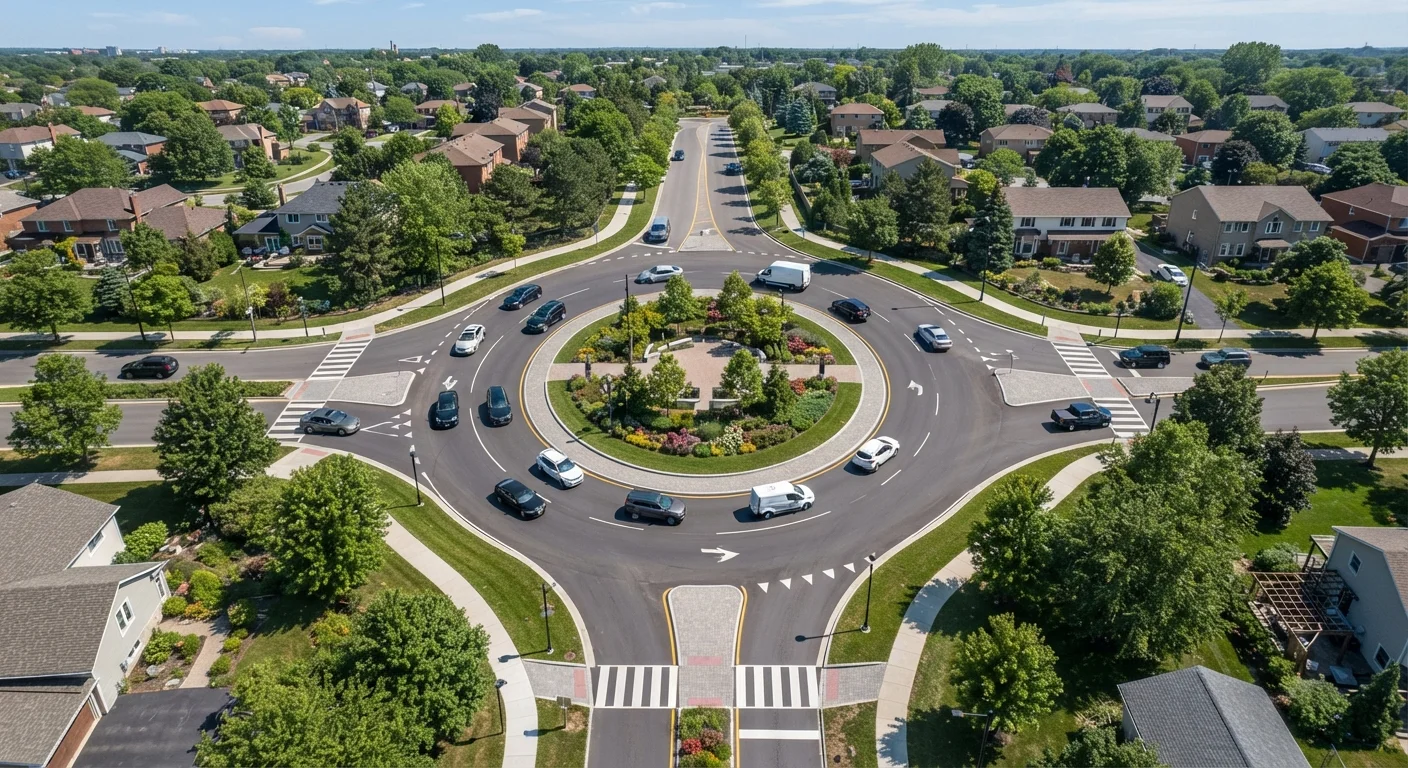
A roundabout is a circular intersection where all traffic moves counterclockwise around a central island. Vehicles enter only when a gap in circulating traffic allows it. The core rule: entering traffic yields to traffic already in the circle. There are no stop lights and no left turns across oncoming traffic.
Common mistakes at roundabouts include stopping inside the circle (don't — keep moving), changing lanes mid-circle without signaling, and failing to yield at the entry point. Pedestrians and cyclists have their own marked crossings, typically just outside the entry and exit points; drivers must yield to them when entering or exiting.
Multi-lane roundabouts add complexity. As a general principle, choose your lane before entering based on your intended exit — right lane for early exits, left lane for exits further around — though markings vary by location and always take precedence over general guidance.
Right of Way
The legal entitlement of a driver, cyclist, or pedestrian to proceed through a given point before others. It assigns who must yield — but does not override the general duty to avoid collisions.
Yield
To slow down or stop to allow another road user to proceed first. A yield does not always require a full stop, but it requires giving the other party clear passage.
Roundabout
A circular intersection where vehicles travel counterclockwise around a central island. Entering vehicles yield to those already circulating inside.
All-Way Stop
An intersection where every approach has a stop sign, requiring all vehicles to stop before proceeding. Right of way is determined by order of arrival, then by position (yield to the right).
Uncontrolled Intersection
An intersection with no traffic signs or signals. Drivers rely on default state right-of-way rules, typically yielding to traffic already present and to vehicles approaching from the right.
Circulating Traffic
Vehicles already moving inside a roundabout. Entering drivers must yield to circulating traffic before merging into the flow.
Four-Way Stops: Order of Arrival and the Tie-Breakers
At an all-way stop (also called a four-way stop), every driver must come to a complete stop before proceeding. Right-of-way follows a straightforward hierarchy:
- First to stop, first to go. The vehicle that arrived and stopped first has the right to proceed first.
- Simultaneous arrival: yield to the right. If two vehicles arrive at the same time, the driver on the left yields to the driver on the right.
- Simultaneous arrival, opposite directions: If two vehicles face each other and both intend to go straight or turn right, both may proceed. If one intends to turn left, that driver yields to the oncoming vehicle going straight or turning right.
In practice, eye contact, a wave, or a nod can help when the order genuinely isn't clear — but don't assume the other driver will follow the rules. Proceed only when you're confident it's safe.
Uncontrolled Intersections: No Signs, No Signals
An uncontrolled intersection has no stop signs, yield signs, or traffic signals. These appear most often in residential neighborhoods and rural areas. Without posted controls, the default right-of-way rule applies: yield to vehicles already in the intersection, and yield to traffic approaching from your right when arriving simultaneously.
Because there are no physical cues to enforce a stop, uncontrolled intersections demand extra caution. Treat them as you would an all-way stop if visibility is limited or traffic is heavy. Reduce speed well in advance — the same attentiveness you'd apply to following distance on the highway applies here. Our article on following distance and reaction time explains why slowing early gives you more options if something unexpected happens.
One additional scenario: a road ending in a T-intersection. Traffic on the through road generally has right of way over drivers approaching from the terminating road. If no signs indicate otherwise, treat the terminating road as a yield situation.
Intersection awareness is one piece of the larger picture. For context on how intersection decisions fit alongside highway-specific challenges, see merging and lane-change safety on freeways.
~40%
Share of U.S. crashes occurring at intersections
According to the Federal Highway Administration, intersections are among the most dangerous locations on the road network.
Up to 90%
Reduction in fatal crashes at roundabouts vs. traditional intersections
The Insurance Institute for Highway Safety (IIHS) attributes this to lower vehicle speeds and elimination of head-on and high-speed right-angle conflicts.