

Key Takeaways
Why Speed Limit Myths Persist
Most drivers consider themselves above average behind the wheel — a statistical impossibility that helps explain why speed-related myths stick around. When speeding feels normal and consequences feel distant, it's easy to rationalize behavior that research consistently identifies as dangerous. The myths below aren't fringe beliefs. They circulate in everyday conversation, get passed along in driver's ed lore, and show up in courtroom defenses. Getting them straight matters because speed is a factor in a large share of U.S. traffic fatalities each year.
For a broader look at how driving risks vary by road type and context, see this complete overview of safe driving in America.
Myth
If you're driving with the flow of traffic, you can't get ticketed — and it must be safe.
Fact
Officers can ticket any driver exceeding the posted limit, regardless of surrounding traffic speed. Crash risk increases with speed independent of what others around you are doing.
The "flow of traffic" defense is common but legally unreliable. Traffic law in every U.S. state ties enforcement to posted limits, not to prevailing speeds. An officer observing a cluster of vehicles at 80 mph in a 65-mph zone can stop any of them. More importantly, matching the speed of surrounding vehicles doesn't change the physics of a crash. If anything, high-speed group driving reduces the margin for everyone to react when something goes wrong ahead.
Myth
Speed limits are set arbitrarily — they're often lower than what's actually safe for that road.
Fact
Most speed limits are set through engineering studies that account for road geometry, sight lines, pedestrian activity, crash history, and vehicle mix.
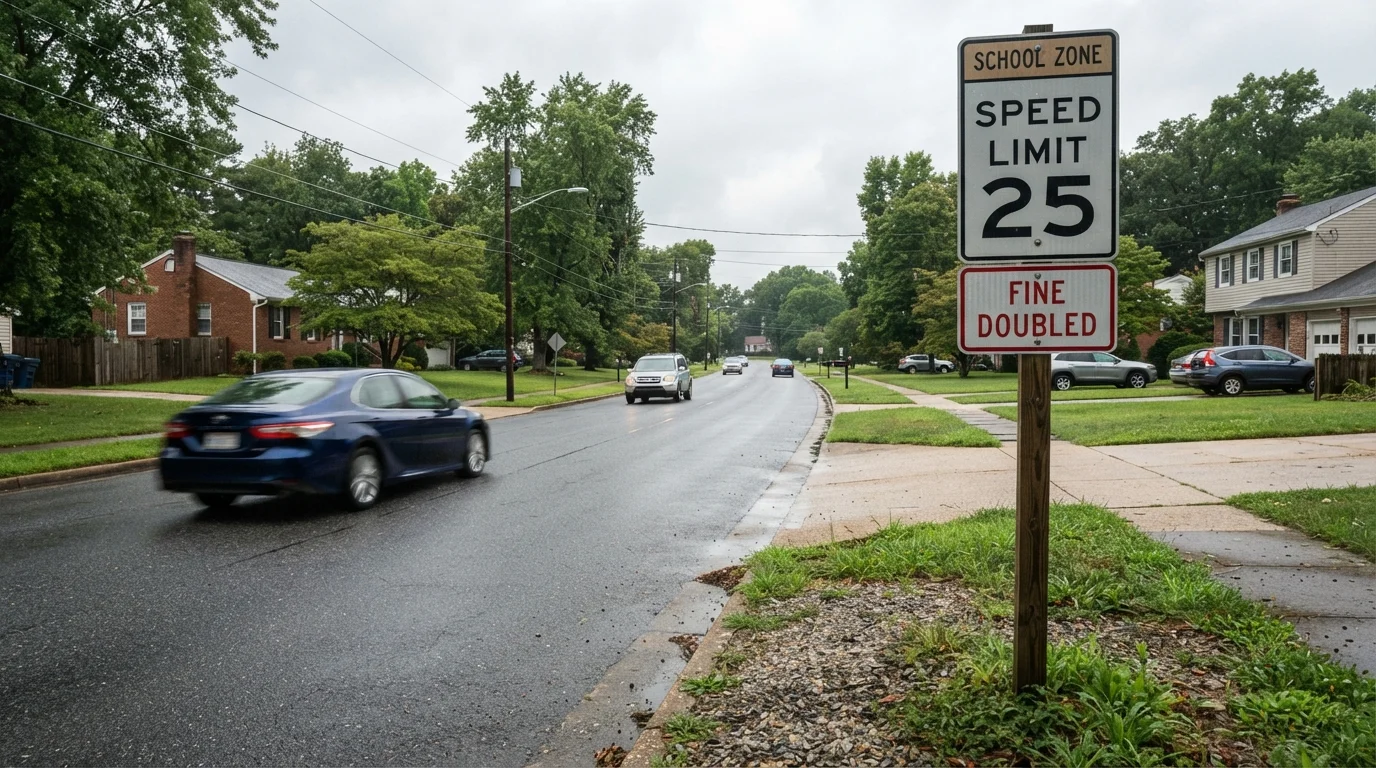
Limits aren't plucked from thin air. Transportation engineers typically use tools like the 85th-percentile speed study — measuring what speed most drivers naturally use — combined with crash records and roadway design standards. The result is sometimes criticized for producing limits some drivers feel are too low, but those limits reflect documented safety trade-offs, not bureaucratic guesswork. Residential and school-zone limits in particular reflect vulnerability of pedestrians, not just vehicle dynamics.
Myth
Posted speed limits are just suggestions — especially on rural highways.
Fact
Posted speed limits are enforceable law. Advisory speed signs (usually yellow) are suggestions; regulatory signs (white) are not.
The distinction between advisory and regulatory signs is real and important. Yellow diamond-shaped signs with speed numbers — often seen before curves — indicate a recommended safe speed for that feature. White rectangular signs with black text are regulatory limits with legal force. Confusing the two is an honest mistake, but treating any posted limit as optional exposes drivers to both legal risk and real physical danger. Rural highways in particular have high fatality rates partly because higher speeds and longer emergency response times combine badly.
Myth
Modern cars are so safe that speed matters much less than it used to.
Fact
Vehicle safety technology reduces injury severity in certain crashes but cannot overcome the fundamental physics of high-speed impacts.
Airbags, crumple zones, electronic stability control, and automatic emergency braking are genuine advances — and they do save lives. But they operate within limits that speed can quickly exceed. Automatic braking systems, for instance, have detection and response thresholds that high speed can outpace. A pedestrian or cyclist struck at 40 mph faces far worse survival odds than one struck at 25 mph, regardless of the vehicle's safety rating. Technology improves outcomes at the margins; it doesn't neutralize speed as a risk factor.
Myth
Speeding only really matters in bad weather — dry roads at high speed are fine.
Fact
Dry-road crashes at high speed are frequently fatal. Weather compounds risk but isn't required for speed to kill.
A significant share of speed-related fatalities occur under clear, dry conditions. Good weather can actually encourage overconfidence, leading drivers to push speeds further than they would in rain or fog. Dry asphalt provides better traction, but it doesn't extend stopping distance proportionally or reduce crash energy. At highway speeds, even a minor steering error or a sudden obstacle can exceed what any road surface — dry or wet — can compensate for.
What the Physics and Data Actually Show
Understanding why speed limits exist requires grasping two interconnected realities: stopping distance and crash energy. Stopping distance is not linear — it grows with the square of speed. A vehicle traveling at 60 mph needs roughly four times the stopping distance of one going 30 mph. That gap between when a driver perceives danger and when the vehicle actually halts is where crashes happen.
~29%
Share of U.S. traffic fatalities linked to speeding
According to the National Highway Traffic Safety Administration (NHTSA), speeding is consistently cited as a factor in roughly 29% of annual traffic deaths in the United States.
4x
Stopping distance increase from 30 to 60 mph
Because stopping distance grows with the square of speed, doubling your speed roughly quadruples the distance needed to bring a vehicle to a full stop under typical conditions.
~90%
Pedestrian survival rate at 23 mph collision
Research cited by traffic safety organizations estimates pedestrian survival rates drop sharply as vehicle impact speed rises — from around 90% at low speeds to under 50% at higher urban speeds.
Crash energy follows the same exponential logic. A collision at 50 mph releases significantly more energy than one at 35 mph — not just more, but dramatically more — because kinetic energy increases with the square of velocity. This is the physics underneath the fatality statistics, and it doesn't care about driver confidence or years of experience.
Speed also compounds other risks. If you're already dealing with poor visibility, a distracted moment, or a tight merge, higher speed shrinks the margin for error to nearly nothing. Following distance research makes the same point: the faster you go, the more distance — and time — you need that you almost certainly don't have.
Speed and Stopping Distance Are Not Linear
Many drivers assume that going 10 mph faster means needing a proportionally small amount of extra stopping distance. In reality, stopping distance increases with the square of speed — meaning the gap between perception and halt grows far faster than intuition suggests. This is one reason high-speed rear-end collisions are so frequently severe, even when the following driver reacts promptly. Tailgating at any speed makes this problem significantly worse.
Adjusting Habits on Real Roads
Correcting these myths isn't about moral judgment — it's about accurate risk assessment. Driving 10 mph over the limit on a dry interstate on a clear afternoon carries different risk than doing the same in rain, at dusk, or through a construction zone. But the baseline risk is never zero, and the myths above encourage drivers to treat it as such.
Speed-related decisions also interact heavily with road type. High-speed rural highways and dense urban streets have distinct hazard profiles that demand different habits. Highway and city driving carry fundamentally different risks, and a speed that feels manageable in one environment can be genuinely hazardous in another. Similarly, unsafe lane changes and merging at excessive speeds are among the leading contributors to freeway crashes — a reality explored in detail in this look at freeway driving behaviors.
The practical takeaway: treat posted limits as meaningful information about a road's engineered safety envelope, not a bureaucratic floor to exceed whenever traffic allows.
This article is for general informational purposes only and does not constitute legal or safety advice. Always follow posted traffic laws and consult relevant authorities for specific legal questions about traffic enforcement in your jurisdiction.