

Key Takeaways
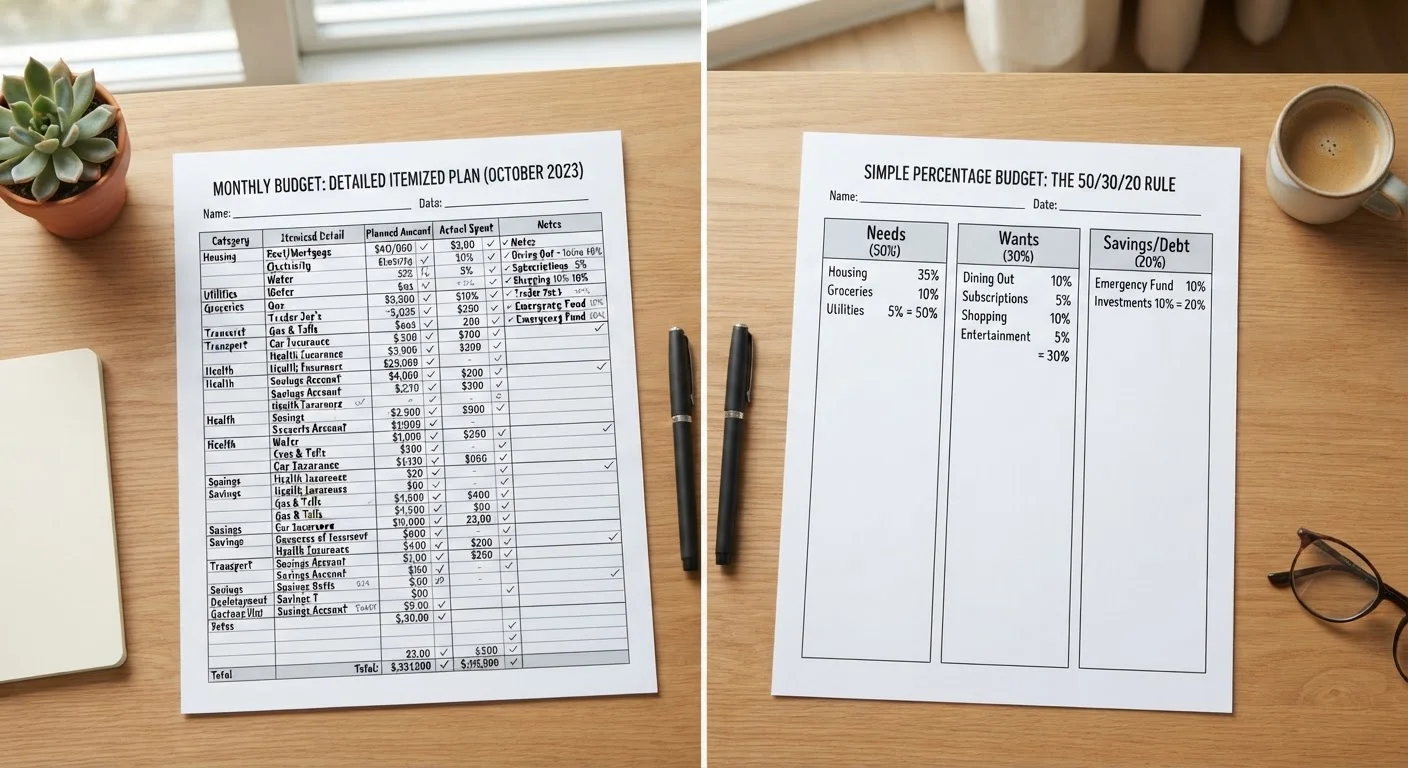
Option A
Zero-Based Budgeting
The meticulous, every-dollar-has-a-job approach.
Best for: People who want precise control over spending and are willing to put in regular tracking time each month.
Option B
The 50/30/20 Method
The simple, percentage-driven framework for busy people.
Best for: People who want a flexible structure without categorizing every single expense.
If you have irregular income or want to stop mystery spending
Zero-Based Budgeting
Assigning every dollar at the start of the month keeps overspending visible immediately, which is critical when income varies or leaks are hard to find.
If you're brand new to budgeting and want a low-friction start
The 50/30/20 Method
Three categories are far less overwhelming than dozens of line items, making it much easier to build a consistent habit from scratch.
If you're aggressively paying off debt or saving for a large goal
Zero-Based Budgeting
Granular control lets you redirect every spare dollar with intention, helping you accelerate payoff timelines more deliberately.
If you have a stable salary and generally healthy spending habits
The 50/30/20 Method
When income is predictable and spending is broadly on track, the 50/30/20 framework provides enough guardrails without demanding heavy maintenance.
If you're managing finances jointly with a partner
The 50/30/20 Method
Broad percentage buckets are easier for two people to agree on and monitor together; for deeper alignment strategies, see our guide on budgeting as a couple.
How Each Method Actually Works
Despite both being called budgets, zero-based budgeting and the 50/30/20 method operate on fundamentally different principles.
Zero-based budgeting starts with your total monthly income and subtracts planned expenses — housing, groceries, transportation, subscriptions, savings contributions, debt payments, and everything else — until the result is zero. That doesn't mean you spend everything; it means every dollar is deliberately assigned somewhere, including savings and investments. You rebuild this plan from scratch each month, which is what makes it both powerful and time-consuming.
The 50/30/20 method divides your after-tax income into three fixed percentages: roughly 50% toward needs (rent, utilities, groceries), 30% toward wants (dining out, entertainment, hobbies), and 20% toward savings or debt repayment. You don't track individual purchases in granular detail — you just monitor whether spending stays within each broad bucket. Our dedicated explainer on the 50/30/20 rule goes deeper on how those categories are defined.
| Criterion | Zero-Based Budgeting | 50/30/20 Method |
|---|---|---|
| Core concept | Every dollar assigned a job | Income split into three percentages |
| Setup time (monthly) | 30–60 minutes per month | Under 20 minutes to start |
| Ongoing tracking effort | High — frequent check-ins needed | Low — broad category monitoring |
| Best income type | Variable or irregular income | Stable, predictable salary |
| Spending visibility | Very granular | High-level only |
| Flexibility | High — rebuilt each month | Moderate — fixed percentages |
| Best for | Debt payoff, specific savings goals | Building a first budget habit |
If you've never built a budget before, a complete monthly budget walkthrough can help you get oriented before committing to either approach.
Effort, Flexibility, and Where Each Method Shines
The most honest difference between these two systems is the time investment they require.
Zero-based budgeting demands a dedicated session at the start of each month — usually 30 to 60 minutes — to allocate income across every category. Mid-month, you'll check actual spending against those allocations regularly. This level of engagement catches small leaks fast: the streaming service you forgot to cancel, the grocery creep that adds $80 a month. The trade-off is real effort. Many people find it sustainable when motivated by a specific goal, like eliminating credit card debt or building a down payment. It also adapts well to months with unusual expenses because you're rebuilding the plan fresh each time.
The 50/30/20 method is lower maintenance. Once you know your after-tax income and have a rough sense of your fixed costs, you can set it up in under 20 minutes. It's forgiving of occasional overspending in one category as long as the overall ratios stay reasonable. However, it can mask specific problem areas — you might stay within your 50% needs bucket while still spending inefficiently on individual line items.
~33%
Americans with no formal budget
A Gallup survey found roughly one in three U.S. adults does not maintain a household budget, suggesting that any consistent system is more effective than none.
78%
Workers living paycheck to paycheck
According to multiple workforce financial wellness surveys, a large share of American workers struggle with cash flow, underscoring the value of structured spending plans.
Importantly, neither method is foolproof if your spending goes untracked. Whichever system you choose, picking the right tool for logging expenses matters. See our comparison of paper, spreadsheet, and app tracking options to find a format that fits your habits.
And if you're hesitant to budget at all, you're not alone — common budget myths may be holding you back more than any real obstacle.
This article is for general informational and educational purposes only. It is not personalized financial advice. Consider speaking with a qualified financial professional about your specific situation.