

Key Takeaways
The 50/30/20 Rule
The 50/30/20 rule is a budgeting guideline that divides your after-tax income into three categories: 50% for needs, 30% for wants, and 20% for savings and debt repayment. It's designed to give you a simple, percentage-based framework for managing money without tracking every dollar. The goal is balance — covering your essentials, enjoying your life, and building financial security at the same time.
The rule was popularized by U.S. Senator Elizabeth Warren and her daughter Amelia Warren Tyagi in their 2005 book 'All Your Worth.' It applies to net income (after taxes), not gross income.
How the Three Buckets Work
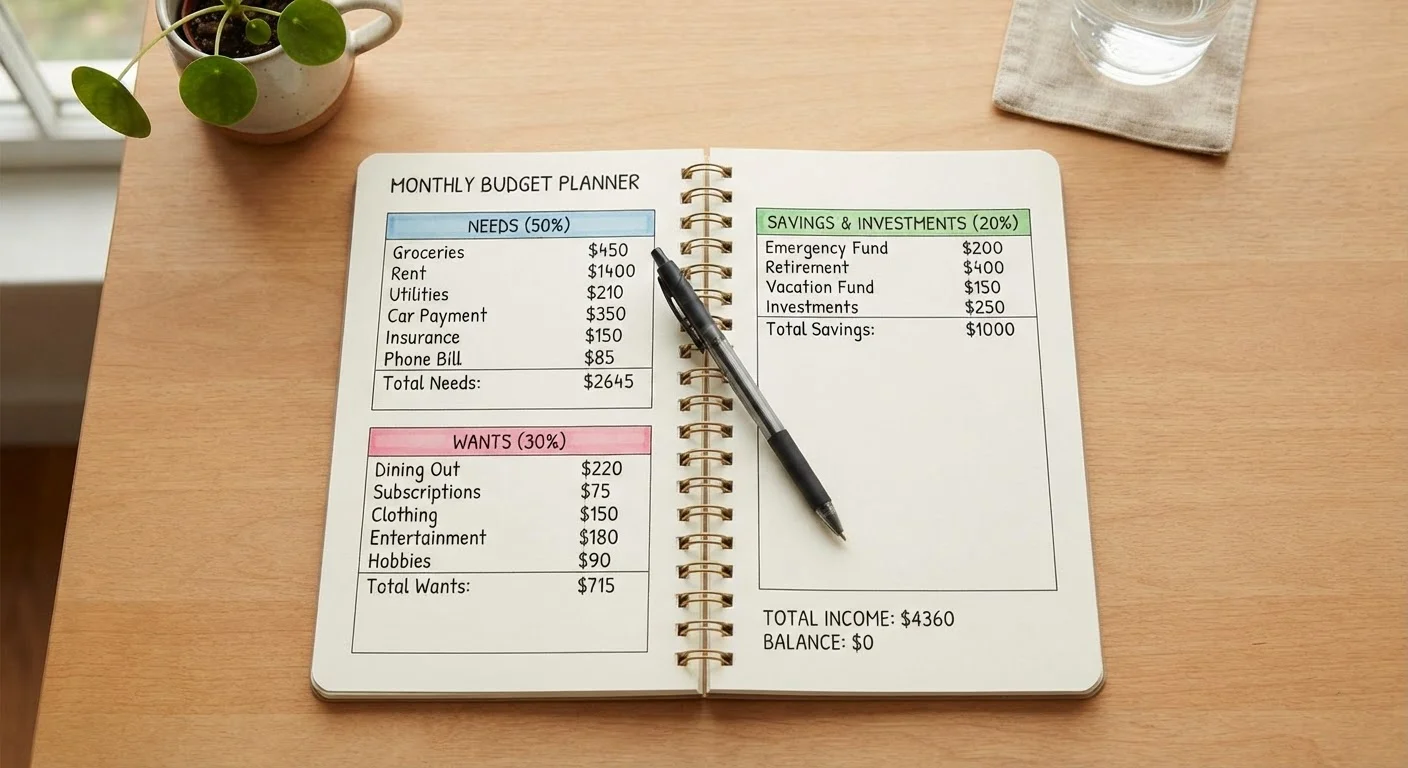
The rule starts with one number: your monthly take-home pay. From there, every dollar gets sorted into one of three categories.
50% — Needs: This covers anything essential for basic living and working. Rent or mortgage payments, utility bills, groceries, health insurance premiums, minimum loan and credit card payments, and basic transportation all belong here. A useful test: if skipping it would cause a serious problem — losing housing, going without food, defaulting on a loan — it's a need. Understanding how to correctly classify your expenses is foundational; see how spending categories work if you're unsure where certain bills fall.
30% — Wants: Wants are the expenses that improve your life but aren't strictly necessary. Streaming subscriptions, restaurant meals, gym memberships, new clothes beyond the basics, and weekend travel all fit here. These aren't frivolous — enjoying your money is a legitimate financial goal — but they're flexible. This category is typically the first place to look if you need to free up cash.
20% — Savings and Debt Repayment: This bucket builds your financial future. It includes contributions to an emergency fund, retirement accounts, and any debt payments above the minimum. Once your emergency fund is in place, this money can flow toward longer-term goals like investing. Explore foundational investing concepts once your savings baseline is established.
50%
Of after-tax income for essential needs
The needs ceiling is the most commonly cited guideline from the 50/30/20 framework, covering housing, food, and minimum debt obligations.
20%
Recommended savings and debt payoff rate
Financial planners commonly cite saving 15–20% of income as a benchmark for long-term financial health, aligning with this rule's savings bucket.
~$9,600
Annual savings on a $4,000/month take-home
Applying the 20% rule consistently to a $4,000 monthly net income produces nearly $10,000 in savings per year before any investment growth.
A Practical Example
Say your monthly take-home pay is $4,000. Here's how the rule would divide it:
- $2,000 (50%) toward rent, utilities, groceries, insurance, and minimum debt payments
- $1,200 (30%) toward dining, entertainment, travel, and personal spending
- $800 (20%) toward an emergency fund, retirement contributions, or extra debt payments
That $800 monthly savings contribution adds up to $9,600 per year — a meaningful step toward financial stability without requiring you to account for every purchase. The Saving & Debt hub offers further guidance once you're ready to put that 20% to work.
When the Rule Needs Adjusting
The 50/30/20 rule is a guideline, not a mandate. Two situations commonly require a different approach.
High cost-of-living areas: In cities where housing alone can consume 40% or more of income, hitting 50% for all needs may be impossible. In these cases, the rule still provides a directional target. You might temporarily run 60/20/20 and work toward a better ratio as income grows or housing costs change.
High-interest debt: If you're carrying credit card balances with double-digit interest rates, aggressively paying them down often makes more financial sense than sticking to a 20% savings ceiling. Redirecting part of the wants budget to debt can save significantly in interest over time. Learn how to prioritize saving versus debt payoff based on your specific situation.
If you want more precision than percentage buckets provide, a different structure might serve you better. Compare zero-based budgeting with the 50/30/20 method to see which approach fits your style and circumstances.
Start by tracking, then adjust
Before restructuring your spending, spend one month recording every expense and categorizing it as a need, want, or savings contribution. Most people are surprised by what's been slipping into the wrong bucket. This baseline makes the 50/30/20 percentages much easier to apply accurately.
This article is for general informational purposes only and does not constitute personalized financial advice. Consider consulting a qualified financial professional for guidance tailored to your situation.