

Key Takeaways
What Hotel Safes Are Actually Designed to Do
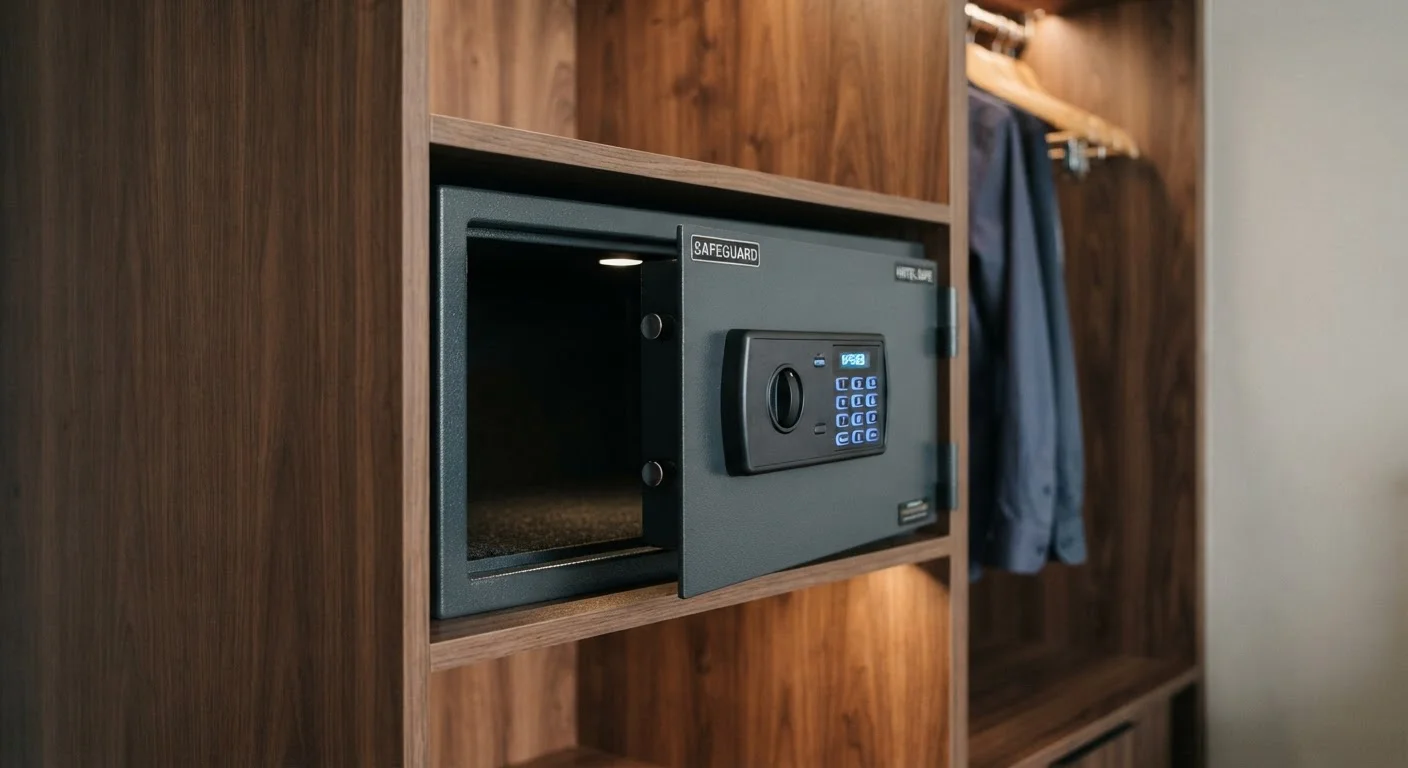
Hotel room safes occupy a specific, limited role in travel security. They are engineered primarily to deter opportunistic theft — the kind committed by someone with brief, unsupervised access to a room who is not carrying tools or specialized knowledge. For that narrow purpose, they work reasonably well.
Most in-room safes are bolted or anchored to furniture or a closet wall, making a quick grab-and-run difficult. A locked door creates a visible barrier that slows down a casual intruder. In environments where property crimes of opportunity are the main risk, that friction alone has real value.
What hotel safes are not designed to do is resist a methodical, informed attempt at access — and that distinction matters far more than most travelers realize. Understanding this gap is the foundation of any honest assessment of in-room safe security.
Don't Store Irreplaceable Items in an In-Room Safe
Items such as original passports, large amounts of cash, or one-of-a-kind documents carry risks that a standard hotel safe is not equipped to fully address. If a destination or itinerary requires carrying high-value items, speak directly with the hotel about front-desk storage options and review your travel insurance policy for coverage terms before you arrive.
Common Myths — and What the Evidence Actually Shows
Travelers carry a cluster of assumptions about hotel safes that feel intuitive but don't hold up under scrutiny. The myth-and-fact pairs below address the most consequential of these misconceptions.
Myth
If I set my own PIN on the hotel safe, only I can open it.
Fact
Most electronic hotel safes retain a factory-set or hotel-level override code that bypasses any guest-selected PIN.
Electronic keypads give travelers a reassuring sense of control, but the override function built into nearly all hotel safe models exists precisely so staff can open units when guests forget codes or check out without clearing them. These master codes are often set at the factory and never changed by hotel maintenance teams — and many of the most common defaults are documented in online forums and manufacturer manuals that are freely accessible. A guest PIN adds a layer of inconvenience, but it does not make the safe truly private.
Myth
A locked safe means the hotel is legally responsible if something goes missing.
Fact
Hotel liability for in-room safe theft is typically limited or excluded under state law and hotel terms and conditions.
Most U.S. states have innkeeper liability statutes that cap a hotel's financial responsibility for guest property losses, often at figures well below the value of electronics or jewelry. Hotels commonly post notices — sometimes inside the safe door itself — disclaiming liability for valuables not stored at the front desk. Travelers who assume the safe creates a legal guarantee of reimbursement may find their claim is denied or drastically reduced. Always review both the hotel's stated policy and your travel insurance terms before deciding where to store high-value items.
Myth
Hotel safes are tested and certified to a meaningful security standard.
Fact
In-room hotel safes are generally not required to meet any recognized security rating and vary widely in construction quality.
Unlike commercial safes sold for home or business use — which may carry ratings from organizations such as Underwriters Laboratories (UL) — in-room hotel safes are typically selected by hotel procurement teams based on price and size, not security certification. Many units have thin steel walls, simple locking bolts, and plastic components that can be compromised with minimal tools. The presence of a keypad and a brand name on the door does not signal a tested level of security. Travelers should treat an in-room safe as a deterrent, not a vault.
Myth
Putting valuables in the safe means I don't need to worry about them for the rest of my stay.
Fact
Safe use is one layer of protection, not a complete solution — ongoing awareness and backup strategies still matter.
A locked safe reduces risk from one specific threat: an unequipped opportunistic intruder. It does nothing to protect against front-desk data breaches, key card duplication, social engineering of hotel staff, or theft during the moments when you're loading or unloading the safe. Travelers who feel completely at ease after closing the safe door may become less vigilant about complementary habits — like keeping room number private, securing door latches, or maintaining digital security hygiene. A calm, layered mindset serves better than false certainty.
Smarter Strategies for Protecting High-Value Items
Once travelers recognize a hotel safe's real limitations, they can build a more effective layered approach. No single solution covers every scenario, but combining methods substantially raises the bar for any would-be thief.
- Use the safe for low-to-mid-value convenience items. Keeping a secondary debit card, a small amount of local currency, or a spare phone charger in the safe is perfectly reasonable. The calculus changes for items that are irreplaceable or financially significant.
- Carry your passport on your person when possible, or use the safe as a backup while keeping a certified photocopy elsewhere. For a thorough breakdown of how to manage your most critical documents, see our guide on protecting your passport, cards, and cash while traveling.
- Consider front-desk storage for truly high-value items. Most hotels offer a main safe or safe-deposit boxes at reception, which are generally more robust than in-room units and covered under different liability terms. Ask about the hotel's written policy before handing anything over.
- Check your travel insurance policy. Some policies cover theft of belongings from a hotel safe, but sub-limits and exclusions for unattended items or inadequate security can apply. Our explainer on what travel insurance covers and what it doesn't breaks down how to read those terms clearly.
- For digital devices, physical security is only half the picture. See our guide to digital security on the road for habits that protect your data even if a device is taken.
The goal isn't to be anxious about hotel rooms — it's to make deliberate, informed choices rather than default ones. If you're interested in separating other common travel security fears from reality, travel safety myths that keep people from going anywhere is a useful companion read.
This article is for general informational purposes only. Specific security needs vary by destination and circumstance; verify insurance coverage details directly with your provider before traveling.