

Key Takeaways
Option A
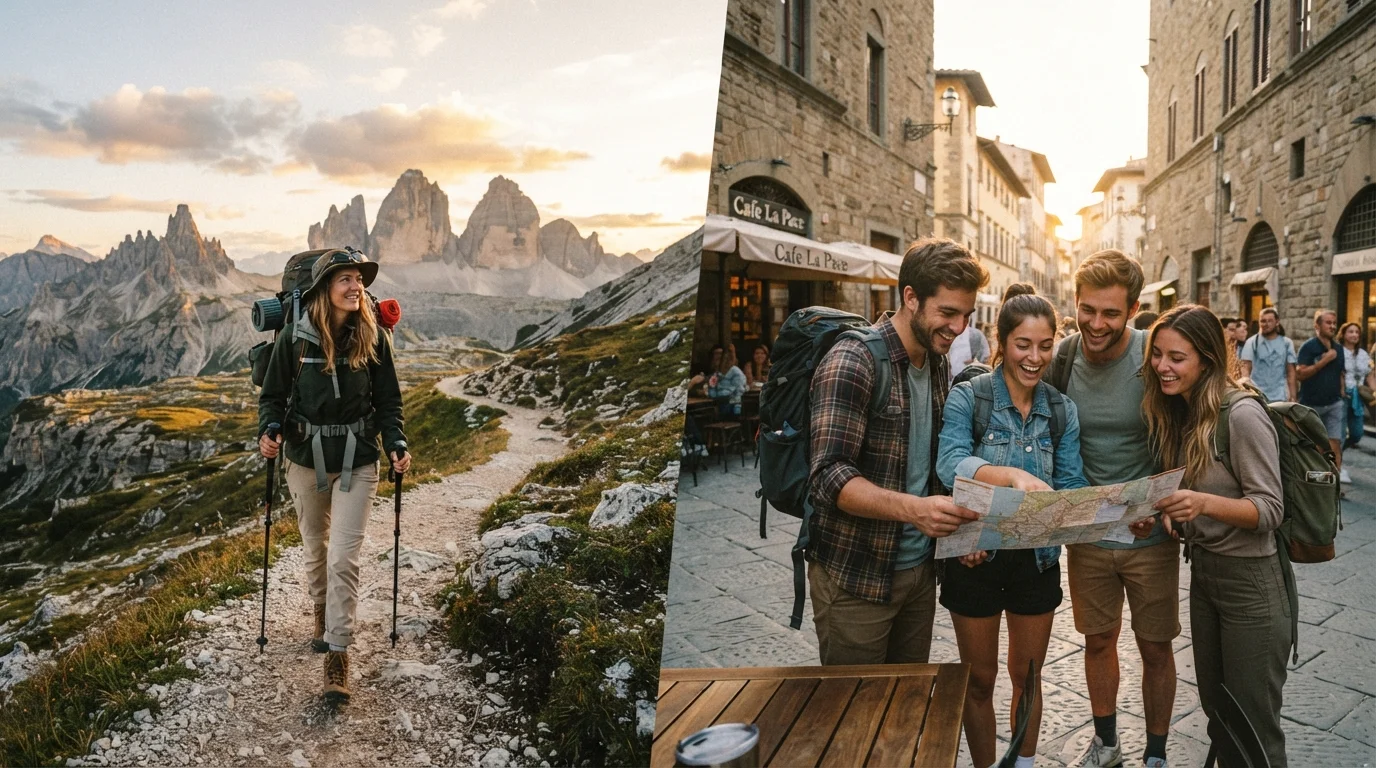
Solo Travel
The self-reliant, flexible approach that demands personal vigilance.
Best for: Independent travelers comfortable making quick decisions and managing all logistics on their own.
Option B
Group Travel
The collaborative approach that distributes responsibility and risk.
Best for: Travelers who benefit from shared awareness, mutual accountability, and collective decision-making.
If you value flexibility and are comfortable managing all decisions independently
Solo Travel
Solo travel lets you adjust plans instantly without group consensus. With solid preparation and communication habits, it's a manageable and rewarding choice.
If you're new to international or unfamiliar destinations
Group Travel
Traveling with others provides a practical safety net in unfamiliar environments, allowing shared problem-solving when situations become uncertain.
If you're visiting a destination with a complex safety landscape
Group Travel
Groups are less likely to be targeted for opportunistic crime and can better handle emergencies through distributed roles and shared resources.
If you want maximum immersion and the ability to adapt your route daily
Solo Travel
Solo travelers can pivot quickly and avoid high-risk areas without negotiating with others, which can be a meaningful safety advantage in fast-changing situations.
The Core Safety Difference: Who's Watching Your Back
The most fundamental safety distinction between solo and group travel isn't about destinations — it's about who carries the load. When you travel alone, every safety decision rests with you: choosing safe routes, trusting your instincts, knowing when to leave a situation, and having a plan if something goes wrong. When you travel with others, that responsibility is distributed — but distributed doesn't always mean managed.
Solo travelers operate with a sharper situational awareness by necessity. Without companions to share the mental load, you're constantly reading your environment, tracking your belongings, and monitoring for anything that feels off. This heightened attentiveness is one of the underappreciated safety advantages of solo travel. For a grounding introduction to core safety habits that apply to both approaches, see our travel safety primer for first-time travelers.
Group travelers, by contrast, can fall into a division-of-attention trap. When everyone assumes someone else is watching the bags, tracking the route, or monitoring a fellow traveler's wellbeing, gaps emerge. Safety in groups requires intentional structure — not just shared presence.
| Criterion | Solo Travel | Group Travel |
|---|---|---|
| Safety responsibility | Rests entirely with the individual | Distributed, but requires coordination |
| Situational awareness | Heightened by necessity | Can diminish through distraction |
| Vulnerability to targeting | Higher for opportunistic crime | Lower when group is attentive |
| Emergency response capacity | Single person must manage alone | Multiple people can share roles |
| Risk of coordination failure | Not applicable | Significant if unplanned |
| Flexibility to avoid risk | High — decisions made instantly | Lower — requires group agreement |
| Check-in and accountability | Requires deliberate external system | Built-in, but can be overestimated |
Unique Vulnerabilities and Protections by Travel Style
For solo travelers, the primary vulnerabilities are visibility and recovery capacity. A solo traveler is more easily identified as a potential target for opportunistic theft, scams, or unsolicited pressure — particularly in tourist-heavy areas. If something goes wrong, there's no immediate backup. Medical emergencies, lost documents, and navigation failures all fall to one person to resolve.
The mitigation strategy is layered preparation: sharing detailed itineraries with a trusted contact at home, registering with the U.S. State Department's STEP program when traveling abroad, carrying digital and physical copies of key documents, and setting regular check-in times. Our practical planning walkthrough for first-time solo travelers covers these systems in detail.
For group travelers, the vulnerabilities are less obvious but still real. Groups can create a diffusion of responsibility, where individual members stop monitoring their personal safety because the group feels protective. Loud, large, or distracted groups can inadvertently draw attention. Coordination failures — particularly around meeting points, emergency contacts, and who has which shared resources — create risk when the group separates.
The 'Safety in Numbers' Assumption Has Limits
Groups don't automatically mean safer. Research on bystander behavior consistently shows that as group size increases, individuals are less likely to act decisively in ambiguous situations — each person assuming another will respond. This applies to travel too: a large group can paradoxically be slower to recognize and respond to an emerging threat than a single alert traveler. Building explicit roles and communication norms into group travel counteracts this tendency.
Groups also have real protective advantages: witnesses, shared resources, multiple phones and maps, and the ability to divide roles in an emergency. These advantages are most effective when the group has explicitly discussed them before travel, not improvised them under stress.
Building the Right Safety Plan for Each Approach
Effective safety planning looks different depending on how you're traveling — and pretending the same checklist works for both approaches leads to gaps.
Solo travelers should prioritize: establishing a reliable check-in schedule with someone at home; learning a few key phrases in the local language relevant to safety and emergencies; carrying a backup payment method stored separately from their wallet; and identifying the nearest embassy or consulate location before they need it. The solo traveler planning guide walks through these steps in order.
Group travelers should prioritize: designating a point person for emergencies before departure; agreeing on a meeting protocol if the group gets separated; ensuring everyone has the group leader's contact information and the accommodation address; and discussing how the group handles it if one member wants to leave a situation earlier than others. For a deeper look at where group trip logistics break down, see our guide to keeping group trip coordination intact.
Safety considerations also shift by environment — urban and rural settings each introduce different exposures regardless of whether you're alone or with others. See urban vs. rural travel safety for a breakdown of those distinctions. If you're comparing the broader tradeoffs between these two travel styles — including cost and logistics — our article on how solo and group travel compare financially offers useful context.