

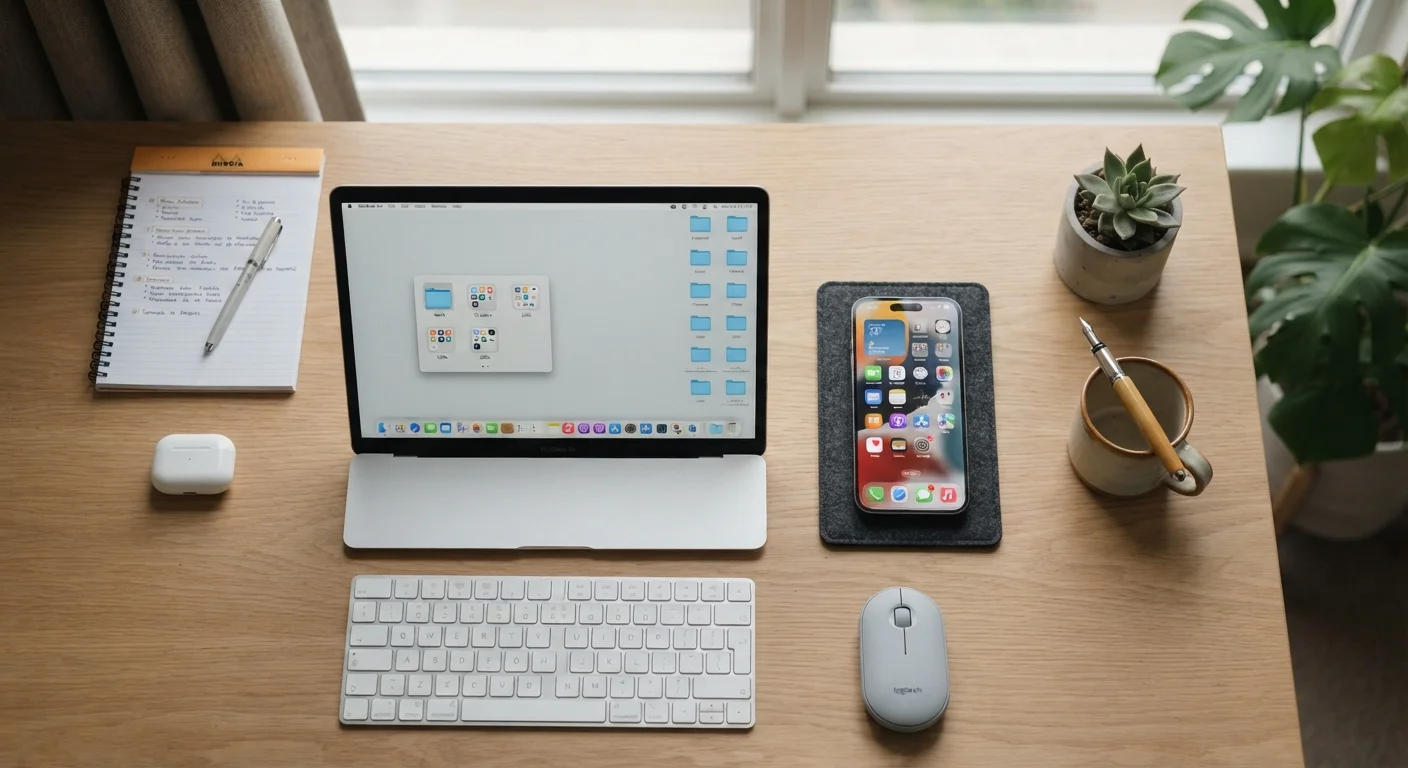
Key Takeaways
Why Digital Clutter Is a Real Problem
Most people wouldn't tolerate a desk buried under hundreds of loose papers — yet many of us carry smartphones and laptops in essentially that state. Dozens of unused apps, files saved to random folders, and a constant stream of notification badges all compete for attention throughout the day.
Digital clutter works the same way physical clutter does: it creates low-level cognitive load, making it harder to focus, find what you need, and feel in control. The good news is that a handful of practical habits can transform how your devices feel to use — and you don't need any special tools to get started. Just like clearing physical clutter, the process works best when it's gradual and intentional rather than a rushed one-time purge.
Organizing Your Apps
Your phone's home screen is the front door to your digital life. If it's crowded and chaotic, every interaction starts with friction.
Audit your installed apps every few months and delete anything you haven't used recently.
Unused apps take up storage, can run background processes, and add visual noise to your home screen. A periodic audit keeps your device leaner and your options clearer.
Group related apps into labeled folders on your home screen.
Folders reduce visual clutter dramatically and make it faster to find what you need. Grouping by function — Travel, Finance, Health — mirrors how you actually think when reaching for your phone.
Keep your primary home screen to only your most-used apps — aim for one screen's worth.
A minimal first screen reduces decision fatigue and the temptation to open apps out of habit rather than intention. Everything else can live in folders or a secondary screen.
Use your device's built-in search instead of scrolling to find apps.
Searching by name is almost always faster than visually scanning a cluttered screen, and it works even when you can't remember which folder something is in.
For a deeper look at how apps affect performance — not just organization — see our article on why apps slow your phone down. You may also find overlooked app settings worth reviewing once your layout is cleaner.
Managing Files and Documents
Whether files live on your device or in cloud storage, the same principle applies: a consistent, logical structure saves time and frustration. If you've ever spent ten minutes hunting for a document you know you saved, you understand why this matters.
Start by creating a small set of top-level folders that reflect your actual life — something like Work, Personal, Finance, and Photos. Within each, add subfolders only as needed, not in advance. Name files descriptively and include a date when the version matters (for example, budget-review-2024-03.xlsx rather than final_FINAL_v3.xlsx).
If you're unsure whether to keep files on your device or in the cloud, our explainer on cloud vs. local storage breaks down the difference in plain language. Understanding where your files actually live helps you make smarter decisions about backups and access.
Taking Control of Notifications
Notifications are the single biggest source of digital interruption for most people. The default setting for almost every app is to send you alerts — because app makers benefit when you engage frequently. That doesn't mean those defaults serve you.
Go through your notification settings (found under your phone's main Settings menu, not inside individual apps) and ask yourself one question for each app: Does this alert require my immediate attention? For most apps — social media, news, shopping — the honest answer is no. Turn those off entirely, or switch them to a "silent" or badge-only mode so you check them on your own terms.
Where to Find Notification Settings
On iPhone, go to Settings > Notifications and tap any app to adjust its alert style. On Android, go to Settings > Apps, select the app, then tap Notifications. Both platforms let you control sounds, banners, lock-screen alerts, and badges independently — giving you fine-grained control without fully silencing an app.
A well-organized notification setup pairs naturally with good device habits overall. Our guide on keeping your devices running well covers related habits that keep your phone and laptop performing reliably.
“Attention is a finite resource. Every unnecessary notification is a small withdrawal from that account — and the balance adds up faster than most people realize.”
— Cal Newport, Author and professor specializing in digital minimalism and focus