

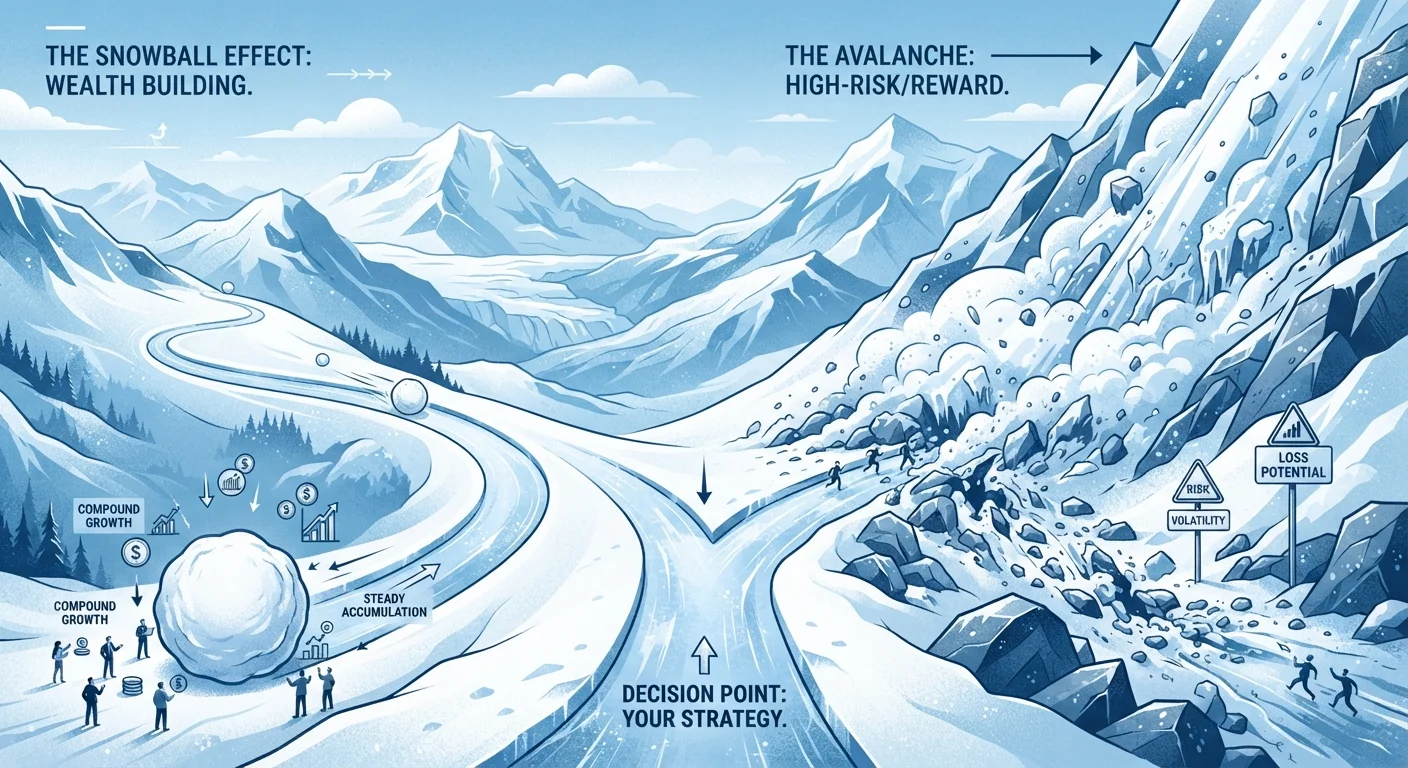
Key Takeaways
Option A
Avalanche Method
The mathematically optimal approach for minimizing total interest paid.
Best for: People motivated by long-term savings who can stay disciplined even without quick wins.
Option B
Snowball Method
The psychologically rewarding approach that builds momentum through early wins.
Best for: People who need visible progress and motivation to stay on track with a debt payoff plan.
If you want to pay as little interest as possible over time
Avalanche Method
Targeting high-interest debt first mathematically reduces the total cost of your debt, assuming you stay consistent throughout the process.
If you've struggled to stay motivated with debt payoff plans before
Snowball Method
Eliminating smaller balances quickly gives you tangible wins that reinforce the habit of paying extra — keeping you engaged for the long haul.
If your debts have similar interest rates but vary widely in balance size
Snowball Method
When interest rates are close, the mathematical advantage of the avalanche shrinks, and the motivational benefit of clearing accounts faster tips the scale.
If your highest-interest debt also happens to be your smallest balance
Avalanche Method
In this case both methods point to the same debt first, so you get the interest savings and the quick win simultaneously.
How Each Method Actually Works
Both the avalanche and snowball methods follow the same basic structure: pay the minimums on every debt each month, then direct any extra money toward one specific target debt. The difference is how you choose that target.
Avalanche method: You rank your debts by interest rate — highest to lowest. Every extra dollar goes to the debt with the steepest rate first. Once that's paid off, you roll that payment into the next-highest-rate debt. Because interest is what causes debt to grow, eliminating the most expensive debt first limits how much extra you'll pay overall. As explained in how interest quietly compounds your balances, high-rate debt left unchecked can cost far more than the original amount borrowed.
Snowball method: You rank your debts by balance — smallest to largest. Every extra dollar attacks the smallest balance first, regardless of its interest rate. Once that account is zeroed out, you redirect its full payment to the next-smallest. The idea, popularized by personal finance educators, is that eliminating accounts entirely generates psychological momentum that keeps you going.
| Criterion | Avalanche Method | Snowball Method |
|---|---|---|
| Payoff order | Highest interest rate first | Smallest balance first |
| Total interest paid | Lower (mathematically optimal) | Potentially higher |
| Speed to first payoff | Slower if high-rate debt is large | Faster — small balances clear quickly |
| Psychological motivation | Reward comes later in the process | Early wins build momentum |
| Best suited for | Disciplined, numbers-focused savers | Motivation-driven, habit-building savers |
| Complexity | Requires tracking interest rates | Simple balance ranking |
The Real Cost Difference Between the Two
In a straightforward mathematical comparison, the avalanche method almost always wins on total interest paid. If your highest-interest debt is a credit card charging 24% APR and you're also carrying a small medical bill at 0% interest, the avalanche tells you to ignore the medical bill until the credit card is gone. That's the right call from a pure numbers standpoint.
The snowball, however, isn't reckless — it just makes a different trade-off. You may pay somewhat more in interest over time, but you reduce the number of open accounts faster. For some people, that sense of forward motion is worth the modest extra cost. Research in behavioral economics consistently finds that visible, near-term rewards improve follow-through on long-term goals — and getting out of debt is nothing if not a long-term goal.
~$1,000+
Potential interest saved with avalanche vs. snowball
The exact savings vary by debt mix, but carrying high-rate balances for even a few extra months can cost hundreds to thousands of dollars in additional interest charges.
~80%
Of consumers with debt carry credit card balances
According to Federal Reserve data, the majority of U.S. households with debt include revolving credit card balances, which typically carry some of the highest consumer interest rates.
The gap between methods shrinks when your debts have similar interest rates or when your smallest balance also carries a high rate. In those situations the snowball and avalanche may point you to the same debt first anyway, making the choice less consequential than it might appear.
Picking the Method That Fits Your Life
There's no universally correct answer here, and anyone who tells you otherwise is oversimplifying. The right method is the one that you'll execute consistently for months or years — because incomplete execution of either strategy costs more than full execution of the other.
Ask yourself a few honest questions:
- Have you tried paying down debt before and quit? If motivation has been your roadblock, the snowball's quick wins may keep you in the game longer.
- Are you comfortable with spreadsheets and tracking numbers? The avalanche rewards patience with quantifiable savings, which can itself feel motivating if you're analytically minded.
- How many accounts do you have? If you're juggling many small balances across multiple creditors, the snowball's account-elimination effect can simplify your financial life faster.
It's also worth thinking about your broader financial picture. Balancing debt payoff with savings goals involves trade-offs that affect which method is realistic given your monthly cash flow. And if you want to see how these strategies fit into a longer plan, a full debt-free roadmap can show you where either method lands in the broader sequence of steps.
What About Debt Consolidation?
Some borrowers consolidate multiple debts into a single loan at a lower interest rate before applying either strategy. If you pursue this route, the avalanche and snowball principles still apply to any remaining accounts. Understanding secured vs. unsecured debt is important before deciding whether consolidation makes sense for your situation. Always review the full terms of any new loan carefully.
Some people start with the snowball to clear a few small accounts, then switch to the avalanche once they feel confident. That hybrid approach has no formal name, but it reflects a practical truth: rigid adherence to a single system matters less than staying engaged with the process. The enemy of debt payoff is inaction, not imperfect strategy.
This article is for general informational and educational purposes only and does not constitute personalized financial advice. Consult a qualified financial professional for guidance tailored to your specific situation.