

Key Takeaways
Diversification
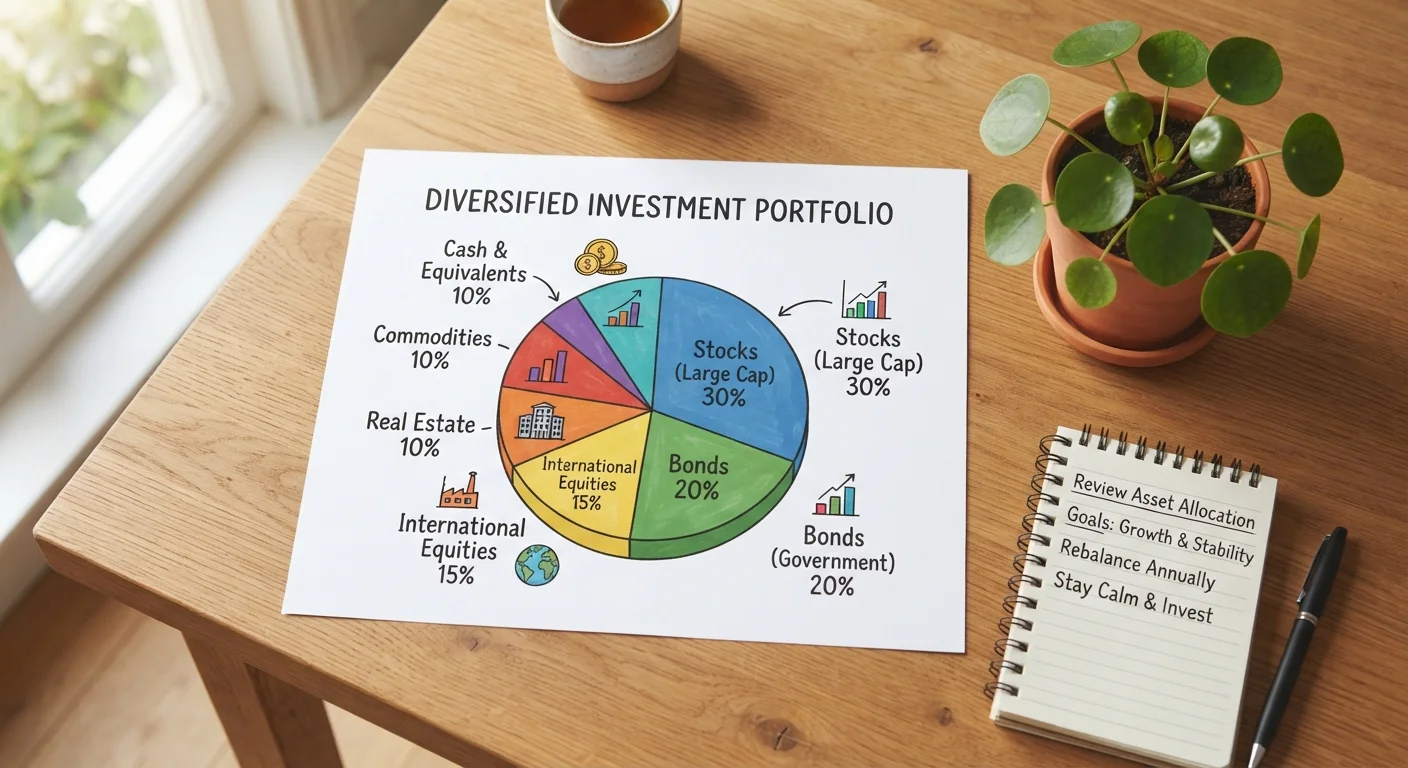
Diversification means spreading your money across different types of investments — such as stocks, bonds, and real estate — so that a loss in one area doesn't wipe out everything you own. The core idea is that different assets often respond differently to the same economic event. When one investment falls, another may hold steady or even rise, softening the overall impact on your portfolio.
In portfolio theory, diversification reduces 'unsystematic risk' — the risk specific to a single company or sector — while 'systematic risk,' which affects the entire market, cannot be diversified away.
Where the "Free Lunch" Idea Comes From
Nobel Prize-winning economist Harry Markowitz is credited with the observation that diversification is the only free lunch in investing. The phrase captures something genuinely useful: by combining assets that don't all move together, an investor can reduce risk without necessarily giving up return. That's a rare trade-off in finance, where reducing risk usually costs something.
The key word is correlation. When two investments are highly correlated, they tend to rise and fall together. When they have low or negative correlation, they often move independently — or in opposite directions. Mixing low-correlation assets is what gives diversification its power. You're not just owning more things; you're owning things that behave differently from each other.
For a fuller grounding in how these concepts fit together, the Plain-English Investing Glossary is a helpful starting point.
How Diversification Actually Reduces Risk
Think of it this way: if all your money is in one company's stock and that company has a bad year, your entire portfolio suffers. But if your money is spread across 50 companies in different industries, a rough patch for one of them barely registers in the overall picture.
The same logic applies across asset classes. Stocks and bonds have historically shown a tendency to move in opposite directions during certain market conditions — when stocks fall sharply, many investors shift money into bonds, pushing bond prices up. Owning both can smooth out your portfolio's swings. Adding real assets like real estate investment trusts (REITs) or inflation-protected securities introduces yet another layer of independence.
~20
Stocks needed to reduce most unsystematic risk
Classic portfolio theory research suggests that holding roughly 20 uncorrelated stocks eliminates most company-specific risk, though the exact figure varies by study and methodology.
500+
Companies in a typical S&P 500 index fund
A single broad-market index fund tracking the S&P 500 holds shares in over 500 large U.S. companies across nearly every major industry sector.
0
Additional cost for correlation-based diversification
Unlike most risk-reduction strategies in finance, mixing uncorrelated assets doesn't require paying a premium — which is why economists call it the only 'free lunch' in investing.
It's worth understanding the two main categories of risk. Unsystematic risk is the danger tied to a specific company or industry — a product recall, a CEO scandal, a regulatory change. Diversification can reduce this kind of risk significantly. Systematic risk, on the other hand, is the risk that affects the entire market — a recession, a global pandemic, a financial crisis. No amount of diversification fully protects against that. Honest investing education means being clear about both.
To understand how different investment vehicles carry their own risk profiles, see how stocks, bonds, and mutual funds compare.
Practical Ways to Diversify
You don't need to hand-pick dozens of individual investments to achieve diversification. Several common investment structures do much of the work for you.
- Index funds hold a basket of securities tracking a market benchmark, instantly spreading your money across many companies. The Index Funds Demystified guide explains how they're built and why they're popular with new investors.
- Target-date funds automatically adjust the mix of stocks and bonds as you approach a specific retirement year, building in diversification that shifts over time.
- Mutual funds pool money from many investors to buy a varied collection of securities under active or passive management.
Geography matters too. Holding some international exposure alongside domestic investments means your portfolio isn't entirely dependent on the U.S. economy's performance at any given moment.
Start Simple, Then Add Complexity
New investors often don't need an elaborate multi-fund strategy. A single target-date fund or a broad index fund covers a lot of diversification ground from day one. As your knowledge and portfolio grow, you can layer in additional asset classes or geographic exposure. Complexity should follow understanding, not precede it.
If you're building your investing foundation from scratch, Investing from Zero: A First-Timer's Complete Roadmap walks through every foundational concept step by step.
What Diversification Won't Do
It's important to be honest about the limits. Diversification is not a shield against all losses. In a severe market downturn, correlations between asset classes can temporarily rise — meaning things that usually move independently start falling together. Investors who lived through 2008 saw this firsthand.
Diversification also won't compensate for poor saving habits or an unrealistic timeline. If you need money in six months, no diversification strategy makes the stock market a safe place for it. The long-term investment mindset principles article covers why time horizon is just as important as asset mix.
Think of diversification as one layer of a sensible approach — valuable, well-supported by evidence, and worth using, but not a substitute for a broader financial plan. A solid budget underpins everything; the Budgeting Basics hub is a good place to start if that foundation still needs work.
This article is for general informational and educational purposes only. It is not personalized financial or investment advice. Consult a qualified financial professional before making decisions about your own investments.