

Key Takeaways
Index Fund
An index fund is a type of investment fund designed to replicate the performance of a specific market index — such as the S&P 500 or the Dow Jones Industrial Average. Rather than having a manager hand-pick stocks, the fund automatically holds the same securities as the index it follows. This makes it a passive investment strategy, meaning it follows the market rather than trying to outperform it.
Index funds can be structured as mutual funds or exchange-traded funds (ETFs). Both track an index, but ETFs trade on stock exchanges throughout the day while mutual fund shares are priced once daily at market close.
What an Index Fund Tracks
To understand index funds, it helps to first understand what an index is. A market index is a list of securities — usually stocks — grouped by a specific set of rules. The S&P 500, for example, tracks roughly 500 large U.S. companies selected by a committee based on criteria like market size and financial stability. The Nasdaq Composite tracks thousands of companies listed on the Nasdaq stock exchange, skewing heavily toward technology. The Bloomberg U.S. Aggregate Bond Index, on the other hand, tracks investment-grade U.S. bonds.
An index fund holds the same securities as its target index, weighted in roughly the same proportions. When a company is added or removed from the index, the fund adjusts accordingly. The fund manager isn't making judgment calls — the index rulebook does the deciding. This is what makes index funds passive: the fund follows the index; the index follows defined criteria; no individual is betting on which stock will win.
For a closer look at what stocks represent in the first place, see what a stock actually is — it's a useful foundation before going deeper into how funds are structured.
How Index Funds Are Structured
Index funds come in two primary structures: traditional mutual funds and exchange-traded funds (ETFs). Both track an index, but they differ in how you buy and sell them.
- Mutual fund index funds are purchased directly through a fund company or brokerage. The price you pay is set once per day, after markets close, based on the fund's net asset value (NAV).
- ETF index funds trade on stock exchanges like individual stocks throughout the trading day. Their price fluctuates in real time based on supply and demand, though it stays very close to the underlying asset value.
For most everyday investors, this distinction matters less than the index being tracked or the fund's cost structure. Either format gives you exposure to the same broad basket of securities.
~$13T+
Assets in U.S. index funds and ETFs
According to Investment Company Institute data, passively managed funds have grown to hold trillions in investor assets, reflecting a broad shift away from active management.
0.05%–0.20%
Typical expense ratio for index funds
Many broad market index funds carry expense ratios well below 0.25%, compared to actively managed funds that often charge 0.50%–1.0% or more annually.
500+
Companies in the S&P 500 index
The S&P 500 includes approximately 500 large-cap U.S. companies across 11 sectors, making it one of the most widely tracked benchmarks in the world.
For context on how index funds compare to other investment types like bonds and actively managed mutual funds, the article on stocks, bonds, and mutual funds walks through the key differences.
Why Low Costs Matter More Than You'd Think
One of the most significant advantages of index funds is cost. Because no one is actively researching and trading securities, the overhead is low. That savings gets passed to investors through a lower expense ratio — the annual fee expressed as a percentage of your investment.
The difference between a 1.0% expense ratio and a 0.05% expense ratio might sound trivial. But over decades, fees compound just like returns do — except fees work against you. On a $10,000 investment growing at 7% annually, a 1% annual fee versus a 0.10% fee can result in a difference of tens of thousands of dollars over 30 years. The math is unforgiving in either direction.
Check the Expense Ratio Before Investing
When comparing index funds that track the same index, the expense ratio is often the most meaningful difference. A lower expense ratio means more of your money stays invested and compounding over time. Look for it in the fund's prospectus or on your brokerage's fund detail page.
This cost advantage is one reason index funds appear so frequently inside retirement accounts. If you're building toward financial goals over the long term, understanding how these vehicles interact with your overall plan is worth exploring in the first-timer's investing roadmap.
Diversification Built In
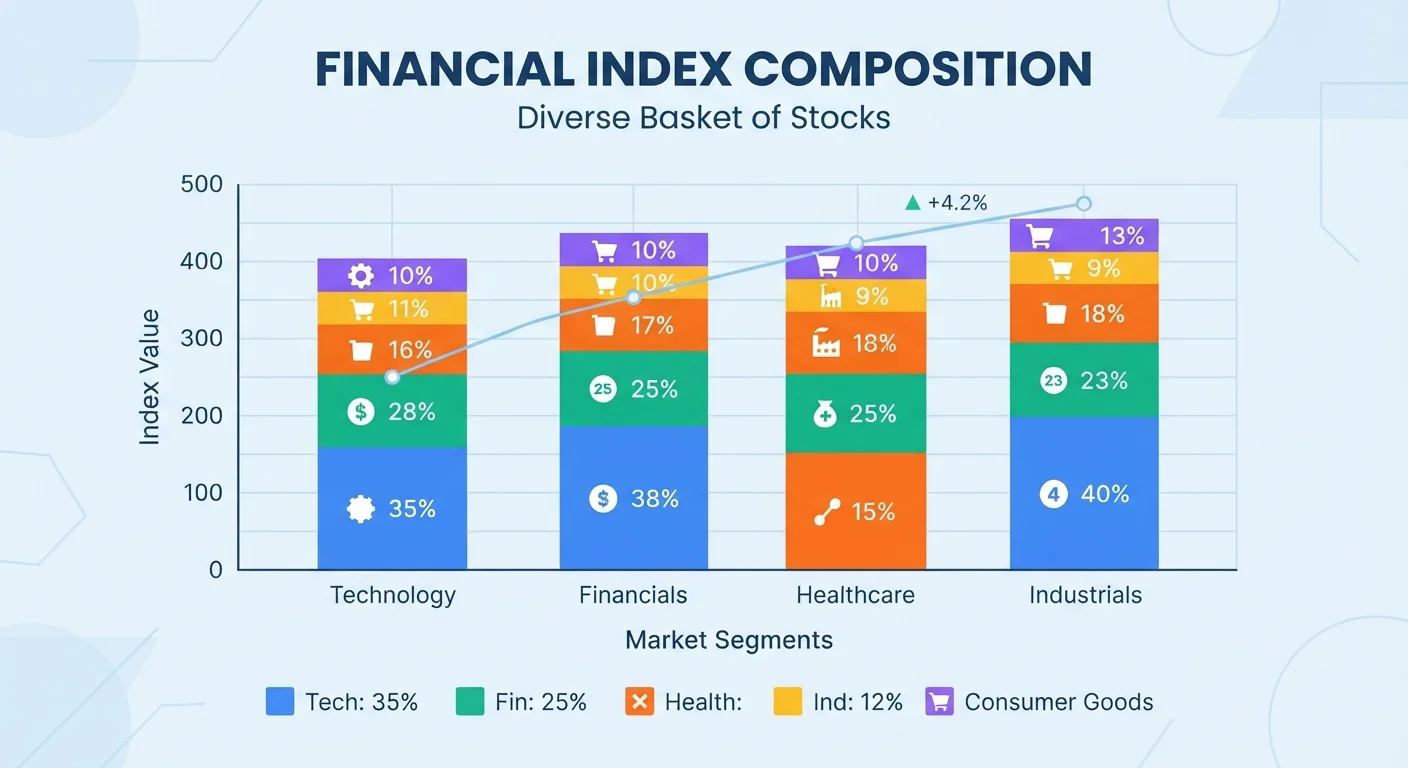
When you buy a single share of an S&P 500 index fund, you indirectly own a small slice of roughly 500 companies — across industries like technology, healthcare, finance, consumer goods, and energy. A single company's bad quarter doesn't sink your investment, because it's offset by the performance of hundreds of others.
This is the core mechanic of diversification: spreading exposure so no single failure can wipe you out. Index funds make this automatic. You don't have to research individual stocks or manually balance a portfolio across sectors. The index structure does it for you.
That said, diversification within a single index fund doesn't mean you're protected from broad market downturns. If the overall U.S. stock market drops significantly, an S&P 500 index fund will drop alongside it. True diversification often means holding across different asset classes — stocks, bonds, international markets — not just many stocks within one market. The concept is explored further in the piece on why diversification matters.
This article is for general informational and educational purposes only. It is not personalized investment advice. Please consult a licensed financial adviser before making investment decisions based on your individual circumstances.