

Key Takeaways
Why Nutrition Labels Can Feel Overwhelming
Nutrition labels were designed to inform, but they can feel like a pop quiz you didn't study for. Numbers, percentages, and scientific-sounding terms crowd a small panel, and it's not always obvious what to pay attention to. The good news: you don't need to understand every line to make better everyday choices. A few anchor points give you most of what you need.
The FDA's standardized Nutrition Facts label format — updated in recent years to reflect current science — follows a consistent structure. Once you learn that structure, reading any label becomes much faster. Think of it as a map: you just need to know the landmarks. If you're just beginning to think about your eating habits, our beginner's guide to daily wellness is a helpful companion starting point.
What you will need
Step-by-Step: Reading the Label
Work through the label from top to bottom — that order actually mirrors how much each piece of information depends on the one above it.
Start with Serving Size
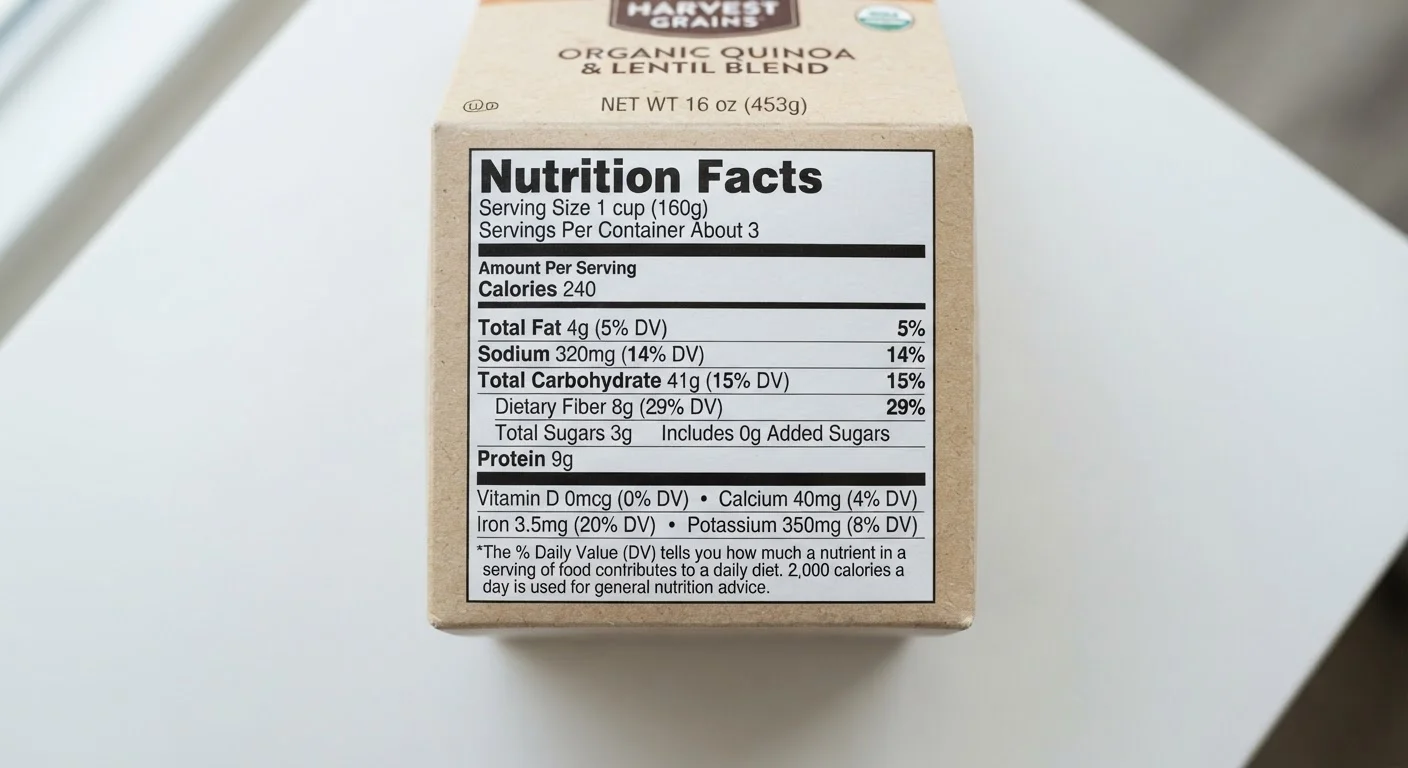
The very first field — serving size — is the most important, because every other number on the label is based on it. If the label says one serving is 1 cup but you pour 2 cups, every value you read doubles. Check the number of servings per container too; a small bag that lists 2.5 servings can be easy to finish in one sitting.
Look at Calories
Calories tell you how much energy one serving provides. This number isn't inherently good or bad — calorie needs vary widely by age, size, activity level, and health status. Rather than fixating on a target number, use calories as a rough reference point for comparing similar foods or gauging portion size. A 50-calorie snack and a 350-calorie snack are meaningfully different, even if the serving sizes look similar.
Use % Daily Value as Your Compass
To the right of most nutrients you'll see a % Daily Value (% DV). This tells you how much of a nutrient one serving contributes toward a general daily intake reference. The FDA's useful rule of thumb: 5% DV or less is considered low; 20% DV or more is considered high. You don't need to add up percentages all day — just use these benchmarks to quickly classify a nutrient as a little or a lot.
Check Added Sugars and Sodium
These two nutrients deserve a closer look for most people. Added sugars — sugars introduced during processing, not naturally occurring — now have their own line on the label, making them easier to spot. Sodium can add up quickly across packaged foods throughout the day. For both, the % DV column is your fastest guide: a high % DV (20% or more) from a single food means that item is contributing substantially to your daily total.
Glance at Nutrients to Seek vs. Limit
The label is organized to help you find nutrients you generally want more of — like fiber, vitamin D, calcium, iron, and potassium — and those many people benefit from watching, like saturated fat and sodium. Fiber, in particular, is something most Americans fall short on; a food with 10–15% DV of fiber per serving is a meaningful contribution. You don't need to optimize every nutrient every meal — just build a general sense of the pattern.
Read the Ingredients List
Ingredients are listed in descending order by weight — whatever appears first makes up the largest portion of the product. A quick scan of the first three to five ingredients tells you a lot about what you're mostly eating. If whole foods (like oats, almonds, or tomatoes) appear at the top, that's informative. If multiple forms of sugar or unfamiliar additives dominate the top slots, that's worth noting. You don't need to be alarmed by long ingredient lists — length alone isn't a reliable indicator of quality — but the order matters.
Focus on Patterns, Not Perfection
No single food defines your diet. The goal of reading labels isn't to find perfectly 'clean' products — it's to build a general awareness of what you're eating across the day. Even a few key data points per item, checked consistently, can meaningfully inform your choices over time.
Putting It All Together in Real Life
Reading labels is most useful when it becomes a quick habit rather than a deep analysis session. A realistic approach: glance at serving size, scan calories, check added sugars and sodium with the % DV in mind, and skim the first three ingredients. That five-second scan covers the majority of what most people need day to day.
Keep in mind that no single food makes or breaks a healthy diet — it's the overall pattern that matters most. Research on habit formation consistently shows that small, consistent choices accumulate into meaningful change over time. Our piece on what healthy habits actually means explores that idea in more depth.
For those interested in how food choices connect to digestive health, our plain-English guide to gut health explains what the science currently says about the gut microbiome. And if you're trying to eat well on the road, practical strategies exist — see our article on eating well while traveling in the U.S. for ideas.
This article is for general informational and educational purposes only and is not a substitute for advice from a registered dietitian or qualified healthcare professional. Individual nutritional needs vary — consult a healthcare provider for guidance tailored to your situation.