

Key Takeaways
Why Food Costs Derail Travel Budgets
For many American travelers, food ends up being the budget category that's hardest to control. It's easy to underestimate how quickly three meals a day — plus snacks and coffee — adds up, especially in high-cost cities or tourist-heavy destinations. A week of reactive eating, grabbing whatever's convenient, can easily cost twice what a thoughtful approach would.
The good news is that eating well on the road doesn't require skipping meals or subsisting on vending machine snacks. It requires a bit of strategy. Whether you're road-tripping across the Southwest or spending a long weekend in a major city, the approaches below can help you eat satisfying, nourishing food without consistently overspending. For a broader look at how food fits into overall trip costs, see building a trip budget that holds up in the real world.
Shop at grocery stores for at least one meal per day
A well-stocked grocery store — whether it's a regional chain or a national brand — is one of the most underused tools in a traveler's food kit. Rotisserie chicken, pre-made salads, deli sandwiches, fresh fruit, yogurt, and cheese are widely available at a fraction of restaurant prices. Many stores also have hot bars and prepared food sections that rival casual dining in quality.
Even buying breakfast staples — instant oatmeal, bananas, peanut butter, and bread — can save $10–$15 per day compared to eating at a hotel restaurant or café. If your accommodation has a mini-fridge, stock it on day one.
A grocery store hot bar can rival casual dining quality at a fraction of the price.
Eat your biggest meal at lunch, not dinner
Many sit-down restaurants offer lunch menus that are nearly identical to their dinner offerings but priced meaningfully lower. Lunch specials, prix-fixe midday menus, and smaller portions at reduced prices are common at everything from casual American diners to upscale regional restaurants.
By making lunch your main meal and keeping dinner lighter — a grocery store find, a food truck, or leftovers — you can experience quality local cuisine without paying peak dinner prices. This also tends to align well with sightseeing rhythms, giving you energy when you need it most.
Lunch at a sit-down restaurant often delivers the same quality as dinner at a lower price.
Seek out ethnic neighborhood restaurants
Restaurants in immigrant communities — whether a Vietnamese pho shop, a Mexican taqueria, an Indian lunch buffet, or a Korean tofu house — consistently offer some of the most generous portions and lowest prices in any American city. These establishments often operate on volume rather than markup, and the cooking is frequently made from scratch using traditional methods.
Exploring these neighborhoods also adds depth to a trip that tourist-zone restaurants rarely provide. Ask locals, check community boards at libraries or community centers, or look at neighborhood-specific food guides rather than generic travel apps that tend to surface the same high-profile spots.
Immigrant-community restaurants often deliver the best value and most authentic cooking in any city.
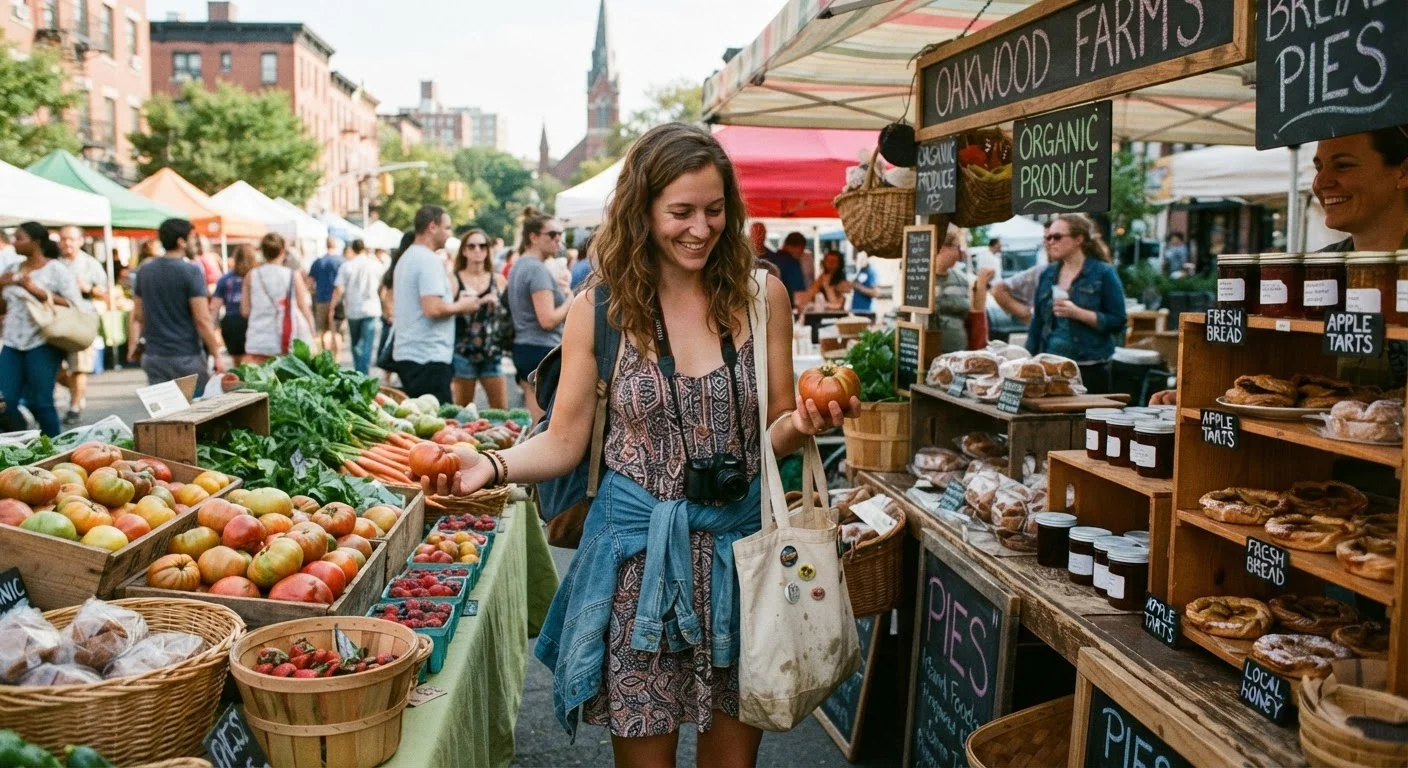
Visit farmers markets for ready-to-eat local food
Most mid-size and large American cities have at least one active farmers market, and many operate on weekends year-round. Beyond raw produce, these markets often feature prepared food vendors: tamales, wood-fired flatbreads, handmade empanadas, smoked meats, fresh juices, and locally made cheeses.
Prices are often comparable to or lower than casual restaurants, and the quality is frequently higher. A market visit also doubles as a genuine local experience — the kind that free and low-cost activities are built around. Check local city websites or community event listings to find markets in your destination.
Farmers market prepared food vendors often match restaurant quality at lower prices.
Pack snacks and a reusable water bottle
Impulse food purchases — a $6 granola bar at a gas station, a $4 bottle of water at a museum, a $9 airport pretzel — are among the most common ways travel food budgets quietly erode. Packing a small bag of portable, filling snacks — nuts, dried fruit, whole grain crackers, protein bars — before each day's activities prevents the hunger that leads to expensive convenience purchases.
A reusable water bottle that you fill at hotel ice machines, restaurant fountains, or public water stations can eliminate $3–$5 in daily bottled water spending. Over a week-long trip, that's a meaningful reduction with no downside. If you're thinking about how small daily habits connect to overall financial discipline, budgeting basics offer transferable principles that apply just as well on the road.
Packing snacks and a reusable bottle eliminates the most common source of impulse food spending.
Use food halls and public markets strategically
Food halls — large communal eating spaces with multiple independent vendors under one roof — have expanded significantly across American cities in recent years. They offer an efficient way to compare options, accommodate different tastes within a group, and often eat for less than a full-service restaurant would charge.
Unlike mall food courts, well-regarded food halls typically feature local and regional vendors with a genuine focus on quality. They're also useful for travelers who want variety without committing to a single cuisine. Many public markets — like historic covered markets found in several major U.S. cities — combine grocery shopping, prepared food, and local character in a single visit.
Food halls let travelers sample diverse, locally sourced options without full-service restaurant prices.
Small Habits, Bigger Savings
None of these strategies require sacrifice — just intention. The travelers who eat well on a budget aren't necessarily those who know every cheap restaurant in every city. They're the ones who build a few consistent habits: shopping local, choosing the right meal to splurge on, and avoiding the convenience trap that costs the most money for the least return.
Front-Load Your Grocery Shopping
On the first day of any trip, spend 15–20 minutes at a nearby grocery store to stock up on breakfast items, snacks, and drinks. This single habit — done once — tends to anchor the rest of the trip's food spending. Travelers who skip this step are more likely to default to expensive convenience options throughout their stay.
If you're thinking about how food costs connect to your overall travel approach, what budget travel actually means offers a grounded look at the real tradeoffs. And if you're planning your first budget trip, this practical starting point for first-time budget travelers covers the fundamentals from the ground up.