

Key Takeaways
The Stress Response
The stress response is your body's automatic, physical reaction to anything it perceives as a threat or challenge. In a split second, your brain triggers a cascade of hormones that prepare your body to act — speeding up your heart, sharpening your focus, and redirecting energy to your muscles. This reaction is completely normal and was designed to keep you safe.
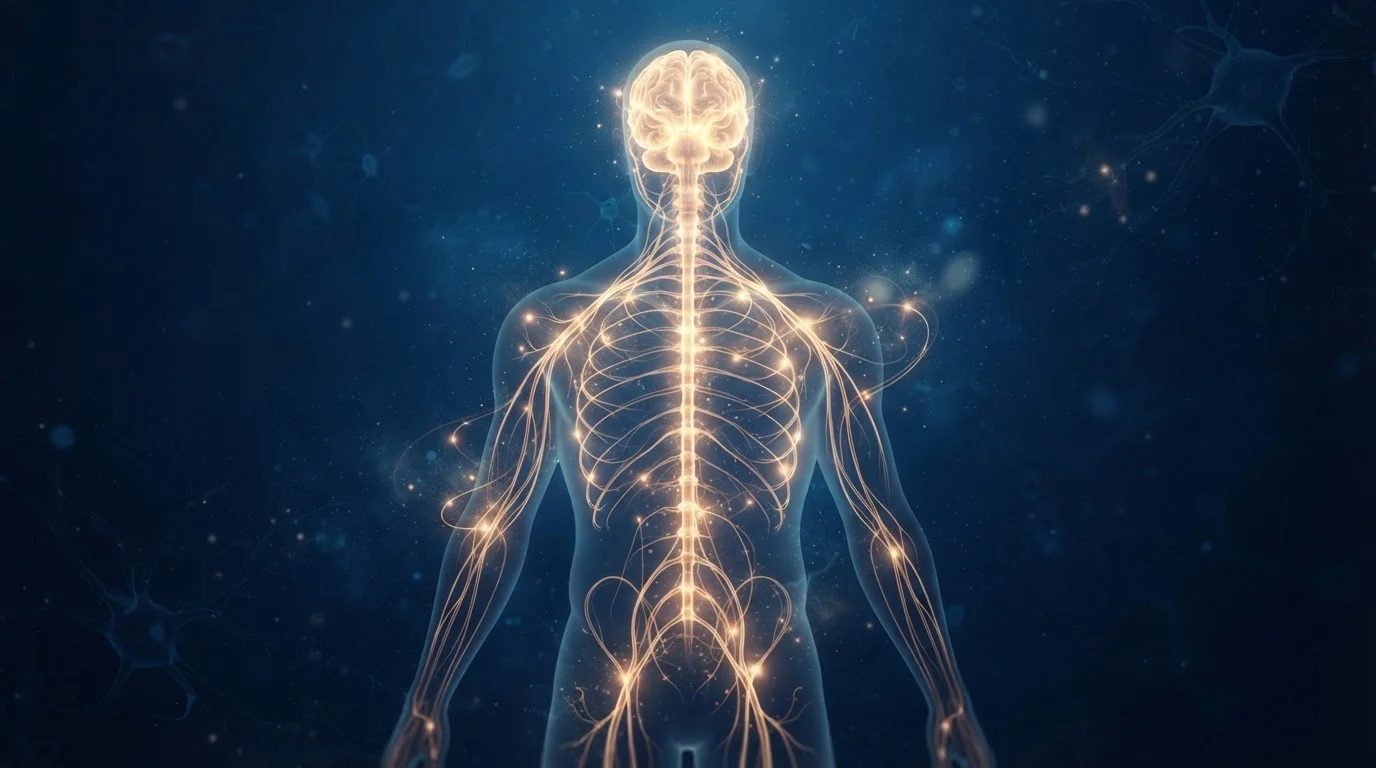
Physiologically, the stress response is coordinated by the hypothalamic-pituitary-adrenal (HPA) axis and the sympathetic nervous system, which together regulate the release of cortisol and adrenaline.
Why Your Body Reacts Before You've Even Thought
Picture this: you're walking to your car at night and a shadow moves suddenly nearby. Before your conscious mind has processed what you saw, your heart is already pounding. That's your stress response doing its job — and it's remarkably fast.
At the center of this reaction is a small, almond-shaped structure in your brain called the amygdala. Think of it as your brain's alarm system. The moment it detects something it considers threatening, it fires a signal to the hypothalamus — your brain's command center — which immediately tells your body to mobilize.
Two things happen almost simultaneously. Your adrenal glands release adrenaline (also called epinephrine), which kicks in within seconds — accelerating your heart rate, tightening your muscles, and dilating your pupils. Then, over the next several minutes, a hormone called cortisol follows, sustaining that heightened state and keeping energy available for action.
This whole system is sometimes called the fight-or-flight response — the body's way of preparing you to either confront a danger or escape it. It's ancient, efficient, and surprisingly well-preserved across human history.
“Stress is not what happens to us. It's our response to what happens — and response is something we can choose.”
— Maureen Killoran, Wellness educator and author
What's Actually Happening Inside You
When your stress response activates, the changes aren't just in your head. Your entire body shifts into a different operating mode.
- Heart rate increases to pump more blood to working muscles.
- Breathing quickens to bring in more oxygen.
- Digestion slows down — your body treats it as non-essential in the moment.
- Blood sugar rises to fuel rapid movement.
- Pain perception temporarily decreases — an evolved advantage in genuine emergencies.
These aren't random symptoms. Each one serves a specific purpose in a survival context. The problem is that your nervous system can produce this same response to a heated email, a traffic jam, or a difficult conversation — situations where running or fighting aren't actually options.
For more on what this means over time, see our overview of how chronic stress affects daily health.
77%
Adults who report physical stress symptoms
According to the American Psychological Association's Stress in America survey, a large majority of U.S. adults regularly experience physical symptoms they associate with stress.
~90 sec
Time for initial adrenaline surge to peak
Research on stress physiology suggests the initial adrenaline response peaks within roughly 90 seconds of a perceived threat, though cortisol effects last considerably longer.
3–5 min
Typical time for breathing to slow post-stress
Studies on autonomic recovery suggest that with deliberate slow breathing, heart rate and respiratory rate can begin to normalize within a few minutes after the stressor is removed.
The Recovery Side Nobody Talks About
The stress response has a counterpart: the parasympathetic nervous system, sometimes called the rest-and-digest system. Once a threat passes, this system gradually brings your body back to baseline — slowing the heart, deepening breathing, and resuming normal digestion.
For many people, this recovery phase is where the challenge lies. Modern life rarely provides a clean "all-clear" signal. Stressors stack on top of each other, and the nervous system never fully gets the message that it's safe to stand down.
Intentional practices can support this return to calm. Slow, controlled breathing is one of the most studied — because it directly influences the vagus nerve, which helps activate the parasympathetic system. Breathing techniques studied in wellness research offer a practical starting point if you're curious about what this looks like in practice.
A Simple Way to Signal Safety
Extending your exhale longer than your inhale — for example, breathing in for four counts and out for six — can help activate the parasympathetic nervous system. This works because the exhale phase is associated with slowing the heart rate. Even a few deliberate breaths can begin to shift your body's state after stress activates.
Understanding what short-term stress looks like — versus stress that lingers — is also worth exploring. Our article on everyday stress vs. chronic stress can help you read the signals your body is sending.
If you'd like a broader foundation, Managing Stress: The Complete Picture walks through causes, effects, and practical strategies in one place.
This article is for general informational purposes only and is not a substitute for professional medical advice. If you're concerned about your stress levels or mental health, please speak with a qualified healthcare provider.