

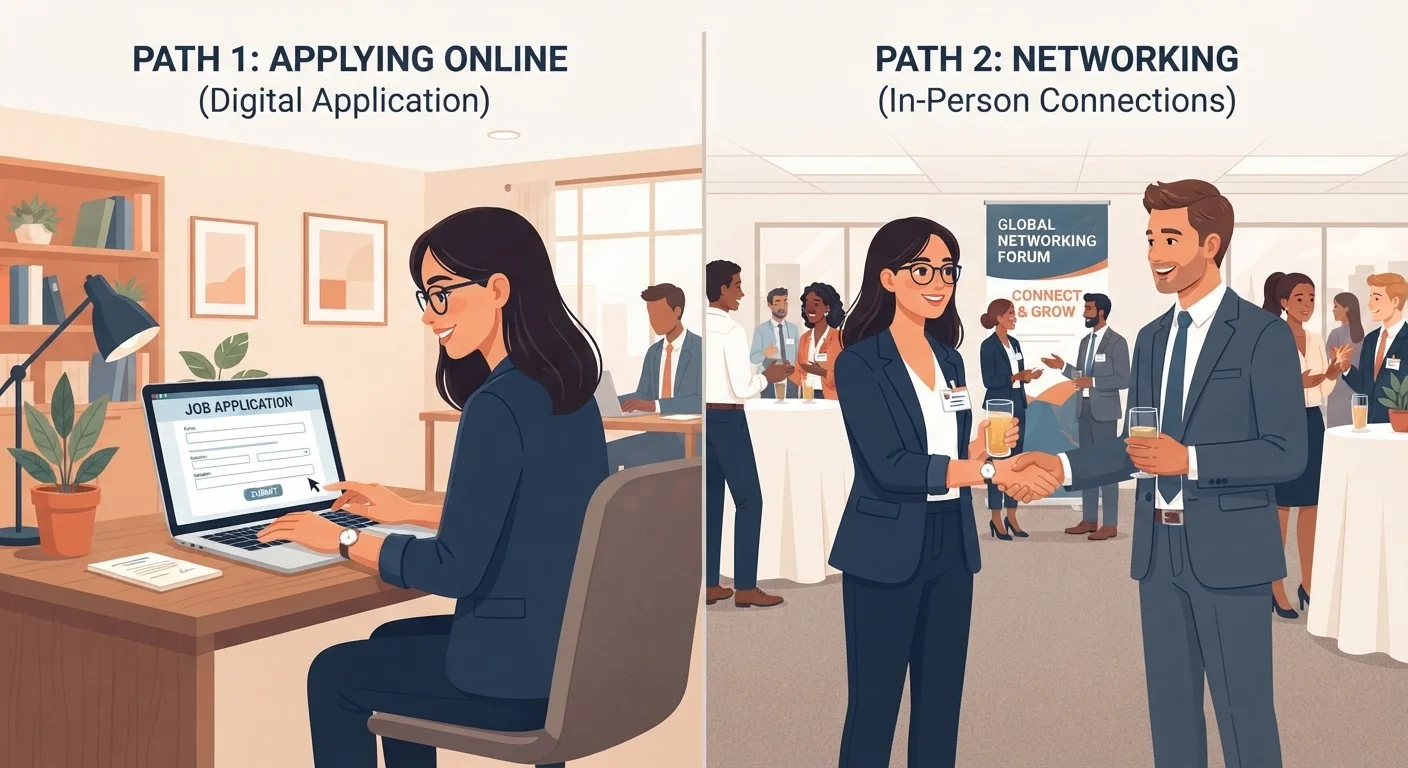
Key Takeaways
Option A
Applying Online
The accessible, structured entry point for job seekers.
Best for: Job seekers targeting clearly defined roles at organizations with formal hiring processes.
Option B
Networking Your Way In
The relationship-driven path to unadvertised opportunities.
Best for: Professionals with an existing industry presence seeking roles that may not be publicly posted.
If you're new to the workforce or changing industries
Applying Online
Job boards give newcomers structured access to roles with clear requirements, making it easier to find entry points without an existing professional network in the field.
If you're a mid-career professional with industry contacts
Networking Your Way In
Your existing relationships are an underused asset. Reaching out to former colleagues and mentors often surfaces opportunities before they're ever posted publicly.
If you need a job quickly and have limited time for relationship-building
Applying Online
Online applications allow immediate action across multiple openings, which is valuable when speed matters more than selectivity.
If you're targeting a specific company or role type
Networking Your Way In
A direct connection inside a target organization can get your resume in front of a hiring manager far more reliably than an application through a job portal.
If you want the strongest long-term job search strategy
Applying Online
Use online applications as your baseline activity while simultaneously cultivating networking relationships — the combination outperforms either tactic alone.
What Each Approach Actually Involves
Online applying means submitting your resume and materials through job boards, company career pages, or applicant tracking systems (ATS) — software that employers use to filter and manage incoming applications. It's the default method most job seekers use, largely because it's fast and accessible. The downside is that every other candidate has the same access, which means popular postings can attract hundreds of applications within days.
Networking, in a job search context, means leveraging existing relationships — or thoughtfully building new ones — to learn about openings, get introductions, or have someone advocate for you internally. This includes reaching out to former colleagues, attending industry events, conducting informational interviews, or simply staying visible in your professional community. It's slower to initiate but often faster to convert into actual interviews.
Neither approach is monolithic. Applying online ranges from sending a tailored application to a single targeted role to blasting dozens of generic submissions — and those two behaviors produce very different results. Similarly, networking can mean a cold LinkedIn message to a stranger or a warm call to a former manager you stayed in touch with. Quality and intent matter in both cases.
| Criterion | Applying Online | Networking Your Way In |
|---|---|---|
| Accessibility | Open to anyone with an internet connection | Depends on existing or developed relationships |
| Speed to apply | Immediate — apply same day | Slower — requires relationship investment |
| Competition level | High — many applicants per role | Lower — referrals face less direct competition |
| Access to unadvertised roles | Limited to posted positions | Strong — surfaces roles before they're listed |
| Conversion to interview | Lower without tailoring or referral | Higher when a contact advocates internally |
| Effort required | Moderate — tailoring applications takes time | High — relationship-building is ongoing |
| Best suited for | Entry-level, career changers, wide search | Mid-career professionals, targeted searches |
The Real Numbers Behind Each Method
The data on job searching consistently points to referrals as a high-value channel. Research from recruiting and HR organizations has found that referred candidates are significantly more likely to be hired than those who apply through job boards, and they often move through the hiring process faster. Some estimates suggest employee referrals account for a disproportionate share of successful hires relative to the volume of candidates who come through that channel.
At the same time, job boards remain the starting point for most searches — and for good reason. They surface roles you might not have heard about otherwise, and for employers that rely heavily on structured recruiting, online applications are the expected entry point. The type of job board you use matters too: general boards, niche platforms, and professional networks each attract different kinds of postings and employers.
70%
Jobs filled through networking, per common estimates
While the exact figure varies by study, multiple workforce surveys suggest a significant majority of positions are filled through relationships rather than public postings alone.
~2–3%
Average online application callback rate
Industry observers and recruiting professionals frequently cite callback rates in the low single digits for cold online applications at competitive employers.
4x
Higher interview likelihood for referred candidates
Research from human resources and recruiting organizations has found referred candidates are substantially more likely to advance to interviews than non-referred applicants.
What the numbers don't capture is that online applications are often filtered before a human ever sees them. ATS software screens for keyword matches, formatting compatibility, and basic qualifications. A well-qualified candidate with a poorly formatted resume can be eliminated before the hiring manager reads a single line. This is why reviewing your materials before submitting is time well spent.
Where Each Method Falls Short
Online applying's biggest weakness is volume — not yours, but everyone else's. When a role receives 300 applications, even strong candidates get lost. High-volume submitting also creates a false sense of productivity. As explored in why mass applying often backfires, sending dozens of generic applications rarely moves the needle the way a focused, tailored strategy does.
Networking has its own friction. It takes time to build relationships, and asking contacts for help can feel uncomfortable — especially if those relationships have gone cold. There's also an equity dimension worth acknowledging: professionals with broader, more established networks often have a structural advantage over those who are newer to an industry, changing careers, or returning after a gap. If that describes your situation, re-entering the job market may require building your network more intentionally before it can work for you.
Finally, not all roles are reachable through either method alone. Some companies post internally first, some rely entirely on recruiters, and some fill roles through referrals before a job ever goes live. Understanding how the hidden job market actually works can help you calibrate how much energy to put into each channel.
How to Combine Both Without Burning Out
The most effective job searches treat online applying and networking as complementary, not competing. A practical division of effort: use online applications to cast a wider net and stay active, while reserving focused networking energy for target companies or roles you genuinely want. That might mean applying to ten roles a week while also scheduling two or three meaningful outreach conversations.
When networking, specificity helps. Instead of asking a contact whether they know of any openings, ask whether they'd be willing to share what they know about a particular company's culture or team. That framing is easier to respond to, less transactional, and often surfaces more useful information. For a more authentic approach to building these relationships, see networking without feeling fake.
Track both channels so you can see what's actually working. If your online applications aren't generating responses after several weeks, that's a signal worth acting on — whether it's your resume, your targeting, or the roles you're pursuing. Recognizing when your strategy needs a reset early saves weeks of wasted effort.
A Note on Equity in Networking
Networking advantages are not evenly distributed. Professionals from under-represented backgrounds, those without college networks, or those returning from career gaps may have thinner networks to start with. This doesn't make networking less valuable — it means building it deliberately and early matters more. Structured programs like professional associations, alumni groups, and mentorship organizations can provide accessible on-ramps for people who don't yet have an established professional circle.