

Key Takeaways
Option A
Hostels
The social, ultra-budget option for flexible travelers.
Best for: Solo travelers, backpackers, and anyone prioritizing low nightly cost and a built-in social scene over privacy.
Option B
Budget Hotels
The private, predictable choice for comfort-conscious savers.
Best for: Couples, families, or travelers who want a private room and consistent amenities without paying full hotel rates.
If you're a solo traveler on a tight budget who wants to meet people
Hostels
Dormitory beds are typically the lowest-cost accommodation available, and common areas naturally connect solo travelers without extra effort.
If you're traveling as a couple or with a family
Budget Hotels
A private room in a budget hotel often costs less per person than multiple hostel beds, while eliminating the shared-space friction.
If reliable sleep and early wake-ups matter to your itinerary
Budget Hotels
Dormitories involve unpredictable noise from other guests; a private room gives you real control over your rest schedule.
If you're traveling a long route and sleeping in a new city every few nights
Hostels
Hostels in major backpacker hubs are built for transient travelers and offer flexible check-in, storage, and community tips that speed up logistics.
If you want a predictable, low-friction base for a work trip or conference
Budget Hotels
Private space, consistent Wi-Fi access, and the ability to keep a professional routine are hard to replicate in a shared dormitory.
What Each Option Actually Gets You
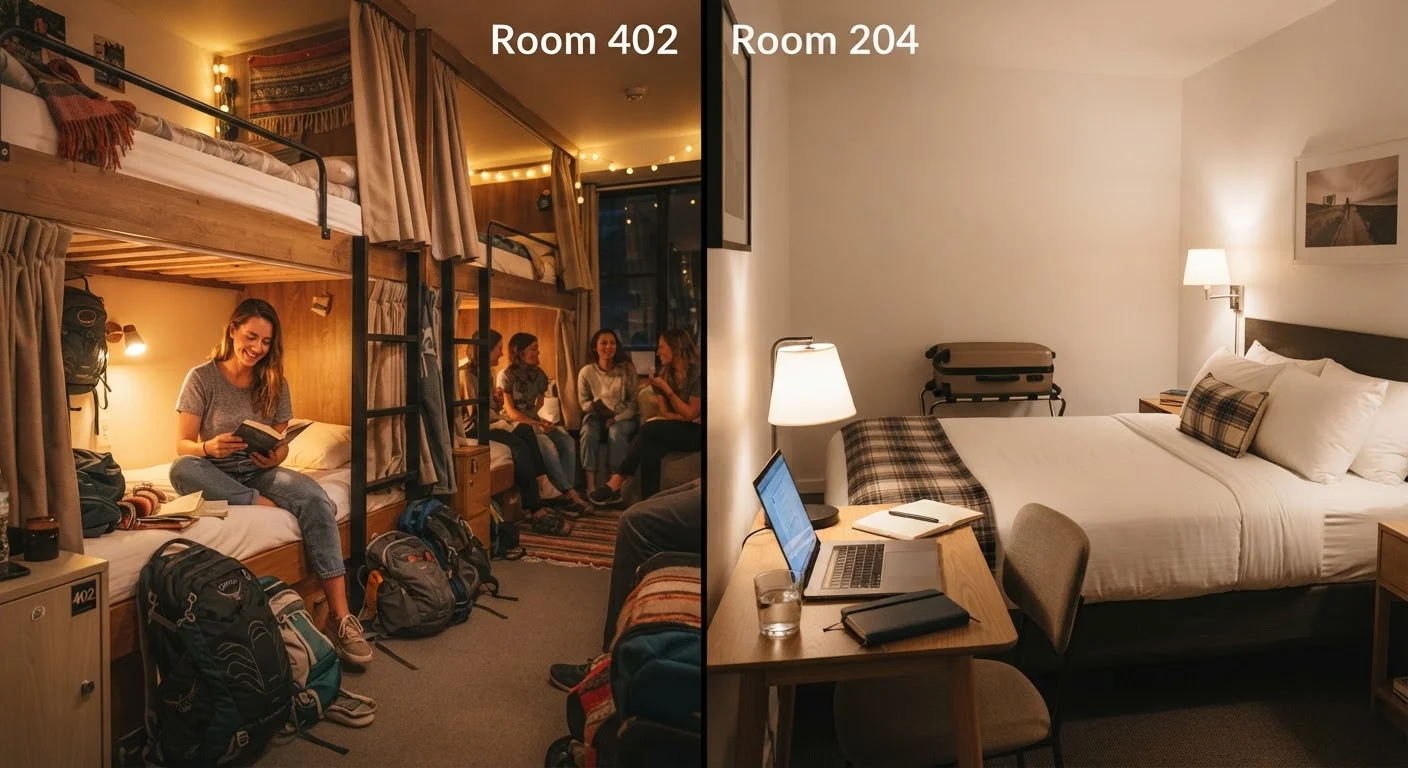
The core difference between hostels and budget hotels isn't just price — it's the fundamental structure of your stay. In a hostel, you're almost always sharing a room with other travelers, typically in bunk-bed dormitories ranging from four to twenty beds. Bathrooms are usually communal. What you get in return is a dramatically lower nightly rate and a ready-made social environment that can be invaluable when you're navigating an unfamiliar city alone.
A budget hotel, by contrast, gives you a private room — sometimes with an en suite bathroom, sometimes shared per floor, depending on the property. You sacrifice the social energy of a hostel, but you gain control: over your sleep schedule, your belongings, and how you spend your downtime. For travelers sharing a room with a partner or splitting the cost two ways, a budget hotel room can be surprisingly competitive on a per-person basis.
Neither option is objectively superior. The right fit depends on what you're optimizing for on a particular trip. As we explore in The Honest Tradeoffs of Traveling Cheap, budget travel always involves real trade-offs, and lodging is where those choices become most personal.
| Criterion | Hostels | Budget Hotels |
|---|---|---|
| Typical nightly cost | Lower (dorm bed) | Moderate (private room) |
| Privacy | Shared room and bath | Private room, often private bath |
| Social atmosphere | Built-in, communal | Minimal to none |
| Kitchen access | Usually included | Rarely available |
| Sleep reliability | Variable (shared space noise) | Generally consistent |
| Best traveler type | Solo, flexible, social | Couples, families, routine-focused |
| Hidden fee risk | Linen, lockers, booking fees | Resort fees, parking, Wi-Fi tiers |
The Real Cost Comparison: Fees, Extras, and Fine Print
Sticker price is only part of the story. Hostels sometimes charge separately for linen rentals, luggage lockers, or towels — costs that can add several dollars per night to a rate that looked unbeatable. Some hostels in popular tourist cities have also adopted booking fees through third-party platforms, narrowing the gap further.
Budget hotels carry their own hidden costs. Resort fees, parking charges, and fees for early check-in or late check-out are common. Wi-Fi, once free nearly everywhere, is increasingly tiered, with faster speeds behind a paywall. Before booking either option, it pays to read the full fee schedule — something our guide on hidden costs that quietly wreck a travel budget covers in detail.
When calculating true cost, factor in meals. Hostels almost always include a shared kitchen, which lets you prepare your own food and cut food spending significantly. Most budget hotels don't offer in-room cooking facilities, meaning you'll spend more eating out. Over a week-long trip, this difference can be substantial.
~$30–$50
Average U.S. hostel dorm bed per night
Hostel nightly rates vary widely by city; urban markets like New York or San Francisco skew significantly higher than the national average.
~$80–$120
Average U.S. budget hotel room per night
Budget hotel pricing fluctuates by season, location, and advance booking window; rates in tourist-heavy cities can exceed this range considerably.
$15–$25
Daily savings using hostel kitchen vs. eating out
Food costs are one of the biggest levers in travel budgets; access to a shared kitchen can meaningfully reduce daily spend over a multi-day stay.
Making the Decision: Factors That Should Drive Your Choice
Before booking, run through a short mental checklist. Who are you traveling with? Solo travelers often thrive in hostels; couples and families rarely do. How much does sleep quality affect your trip? If you have an early flight, a packed itinerary, or you're a light sleeper, shared dormitories introduce real risk. How long is your stay? A single night in a hostel is easy to manage; two weeks in a shared room requires genuine tolerance for communal living.
Also consider your destination. Hostels are abundant and well-developed in backpacker-heavy regions — Southeast Asia, Central America, and many European cities — and the quality gap between a hostel and a budget hotel is often smaller there. In smaller U.S. cities or off-the-beaten-path destinations, hostel options may be limited or inconsistent in quality, making a budget hotel the more reliable choice.
If you're building a multi-stop trip budget from scratch, building a trip budget that holds up in the real world walks through how to estimate lodging costs alongside transport, food, and activities so nothing catches you off guard. And if this is your first budget trip overall, Budget Travel for First-Timers offers a grounded starting framework.
Ultimately, the right lodging is the one that supports the trip you're actually planning — not just the one with the lowest number on the booking page.