

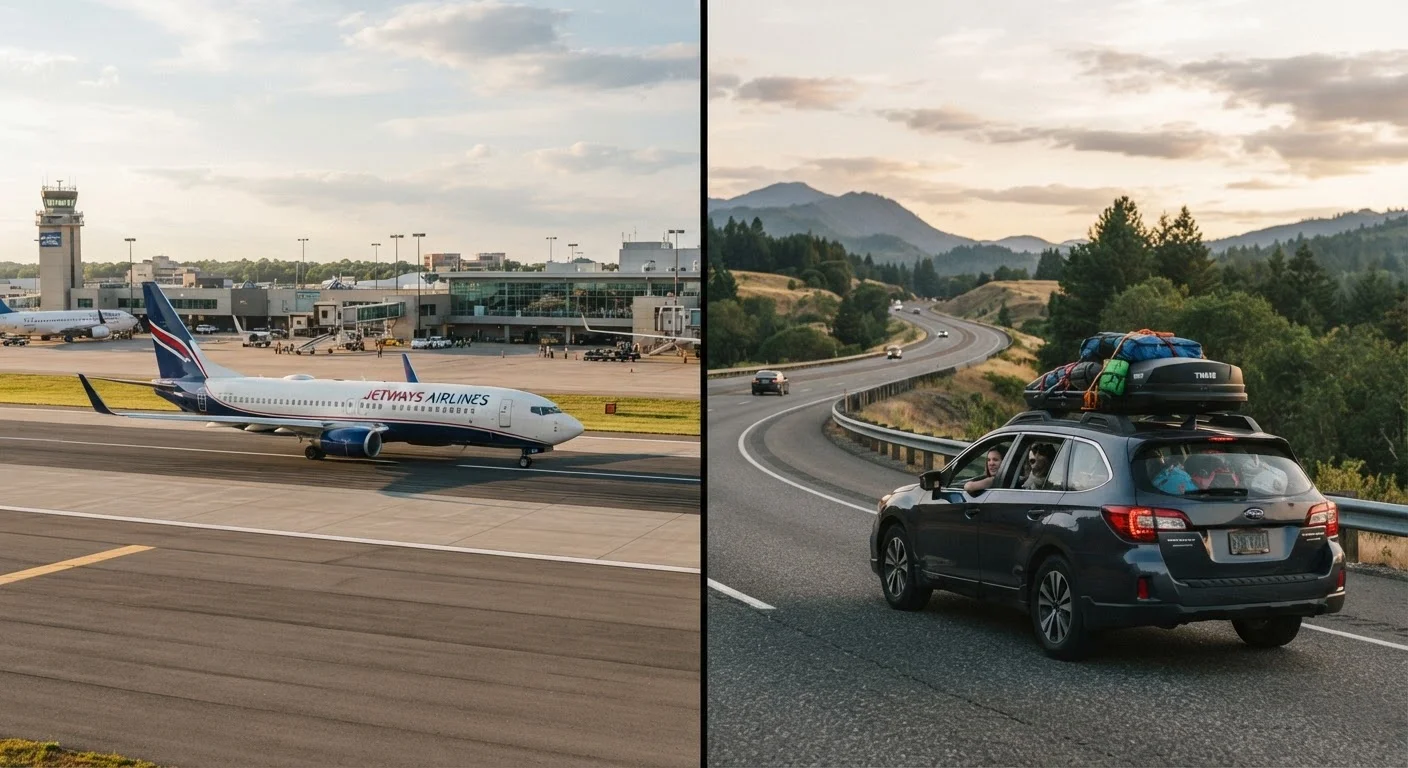
Key Takeaways
Option A
Flying
The fast, fixed-cost option for longer distances.
Best for: Solo travelers or couples covering long distances quickly, where time savings outweigh added fees.
Option B
Driving
The flexible, group-friendly alternative for shorter hauls.
Best for: Families or groups traveling 300 miles or less, especially when luggage, flexibility, or pet travel matters.
If you're traveling solo on a trip over 500 miles
Flying
At long distances, airfare often beats the combined cost of fuel, food, lodging en route, and time away from work for a solo traveler.
If you're traveling with three or more people
Driving
Fuel and road costs split among multiple passengers make driving substantially cheaper per person, even on longer routes.
If your destination is within 300 miles
Driving
Once airport time, fees, and ground transport are factored in, flying rarely saves money or meaningful time on shorter routes.
If you have heavy luggage or are traveling with pets
Driving
Checked bag fees and pet-in-cabin restrictions can add significant cost and stress that driving eliminates entirely.
If your time is the most constrained resource
Flying
On trips over 400 miles, flying — even with airport overhead — typically saves four or more hours compared to driving.
Why the Cheaper Option Isn't Obvious
Most travelers compare a flight price to a gas estimate and call it done. That shortcut misses a significant portion of what each mode of travel actually costs. The true comparison requires accounting for every dollar that leaves your wallet — before, during, and after the journey itself.
As a starting framework: flying tends to favor solo travelers covering long distances, while driving tends to favor groups on shorter or mid-length routes. But the break-even point shifts depending on your specific situation. Understanding the full cost picture is the only reliable way to know which option actually saves you money. See our overview of what budget travel really means for the broader context behind decisions like this one.
The Real Cost of Flying: Beyond the Fare
An airfare price covers exactly one thing: your seat on the plane. The surrounding costs are what catch travelers off guard.
- Baggage fees: Most domestic carriers charge for checked bags. Round-trip fees can add $60–$100 per traveler depending on the airline and bag count.
- Airport transportation: Getting to and from two airports — parking, rideshare, or shuttle — can easily add $40–$100 each way in many cities.
- Airport time: Arriving 90 minutes early, boarding, taxiing, and deplaning adds two to three hours that don't appear in the flight duration. That time has real value.
- Food and incidentals: Airport meals and drinks are priced at a premium. Even a modest airport meal can run $20–$30 per person.
When these are added up honestly, a $150 round-trip fare for one person can realistically become a $280–$400 total cost before the destination is even reached.
| Criterion | Flying | Driving |
|---|---|---|
| Base cost (solo traveler) | Varies by fare; often competitive | Fuel + wear; rises with distance |
| Cost per person (group of 4) | Multiplies x4 | Splits x4; major advantage |
| Baggage | Fees per checked bag | No extra cost |
| Door-to-door time (under 300 mi) | Often similar or longer | Comparable or faster |
| Door-to-door time (over 500 mi) | Significantly faster | Multiple hours or days longer |
| Flexibility | Fixed schedule, limited stops | Full control of route and pace |
| Pet travel | Restricted and costly | Generally straightforward |
| Hidden costs | Airport parking, ground transport, food | Tolls, meals, potential lodging |
The Real Cost of Driving: Beyond the Gas Pump
Gas is the most visible driving cost but rarely the complete one. A more accurate estimate includes:
- Fuel: Divide the round-trip mileage by your vehicle's real-world MPG, then multiply by the current price per gallon. Use your car's actual highway fuel economy, not the EPA label figure.
- Wear and depreciation: The IRS standard mileage rate — which accounts for wear, maintenance, and depreciation — has historically hovered around 65–67 cents per mile. This is a useful benchmark even if you're not deducting anything.
- Tolls: Depending on the corridor, tolls can add $10–$50 or more to a one-way trip in states with heavy toll infrastructure.
- Overnight stays: On trips over eight hours, factor in at least one night of lodging each way.
- Meals en route: Road meals for a family of four add up quickly, especially compared to packing food from home.
The key advantage of driving is that these costs are largely fixed regardless of party size. One car carrying four people splits all costs four ways — making the per-person total dramatically lower than flying. How group size changes travel costs is explored in depth in our companion guide.
~$0.67
IRS per-mile driving cost estimate
The IRS standard mileage rate reflects a composite of fuel, maintenance, and depreciation — a useful benchmark for estimating true driving cost per mile.
2–3 hrs
Typical airport overhead time added per flight
Industry travel guidance consistently recommends arriving 90 minutes before domestic departures, and boarding, taxiing, and deplaning add additional time beyond published flight duration.
~500 miles
Common solo break-even distance
Travel cost analysts generally place the crossover point where flying becomes cost-competitive for solo travelers at roughly 400–600 miles, depending on route and fees.
How Distance Changes the Equation
Distance is the single biggest variable in this comparison. A rough breakdown by mileage:
- Under 200 miles: Driving almost always wins. Even generous airfare pricing can't compete once airport overhead is counted. Total door-to-door time is often comparable.
- 200–500 miles: This is the contested zone. For a solo traveler, airfare may edge out driving. For two or more people, driving typically remains cheaper. Time savings for flying become more meaningful in this range.
- Over 500 miles: Flying becomes increasingly competitive on cost for individuals, and the time advantage becomes substantial for everyone. Cross-country drives (2,000+ miles) involve lodging, meals, and days of travel that usually exceed airfare for most party sizes.
These thresholds are starting points, not rules. Actual costs vary by route, season, vehicle, and how carefully you shop. Before finalizing any transportation decision, it's worth running the numbers as part of a full trip budget. Our guide to estimating trip costs before you leave home walks through that process category by category.
Gas Prices and Airfare Both Fluctuate
Neither driving costs nor airfares are stable. Fuel prices shift with global markets, and airfare varies dramatically by booking timing, route, and season. Any estimate you make today may look different by your travel date. Run your numbers close to when you plan to book, and build a small buffer into your budget for both options. For current fuel prices, the U.S. Energy Information Administration publishes weekly national and regional averages.
Making the Decision That's Right for Your Trip
Rather than defaulting to whichever option feels cheaper, work through a side-by-side estimate specific to your route. Write down every cost for each option — including time if it's genuinely constrained — then divide by the number of travelers.
A few questions worth asking before you decide:
- How many people are traveling? More passengers make driving progressively more economical.
- How much luggage are you bringing? Heavy or oversized bags shift the cost balance toward driving.
- Is overnight travel involved either way? Long drives often require lodging that can erase the savings.
- What does your time actually cost? A day of travel time has real consequences for some trips and none for others.
- Are there flexibility needs mid-trip? Driving offers freedom to stop, detour, and adjust that flying does not.
Understanding these tradeoffs is part of what building a trip budget that holds up in the real world actually means — accounting for what you'll genuinely spend, not just the headline numbers.