

Key Takeaways
Why Windfalls Slip Through Our Fingers
A tax refund hits your bank account. A year-end bonus lands. An unexpected freelance payment comes through. For a moment, it feels like free money — and that feeling is exactly what makes windfalls so easy to waste.
Research in behavioral economics consistently shows that people treat unexpected income differently than regular income. We tend to spend it faster and with less scrutiny, a phenomenon sometimes called the "windfall effect." The result: a meaningful financial opportunity quietly disappears into dining out, impulse purchases, or an Amazon cart you barely remember filling.
The antidote isn't willpower — it's a framework. Before you spend a single dollar of a windfall, give yourself 48 hours and run through the priorities below. The goal isn't to be restrictive. It's to make sure the money works as hard for you as you worked to earn it. For broader context on how spending decisions fit into a monthly plan, see our Budgeting Basics hub.
This article is for general informational and educational purposes only and does not constitute personalized financial, tax, or investment advice. Consult a qualified financial professional before making decisions based on your individual circumstances.
Recognize what a tax refund actually is
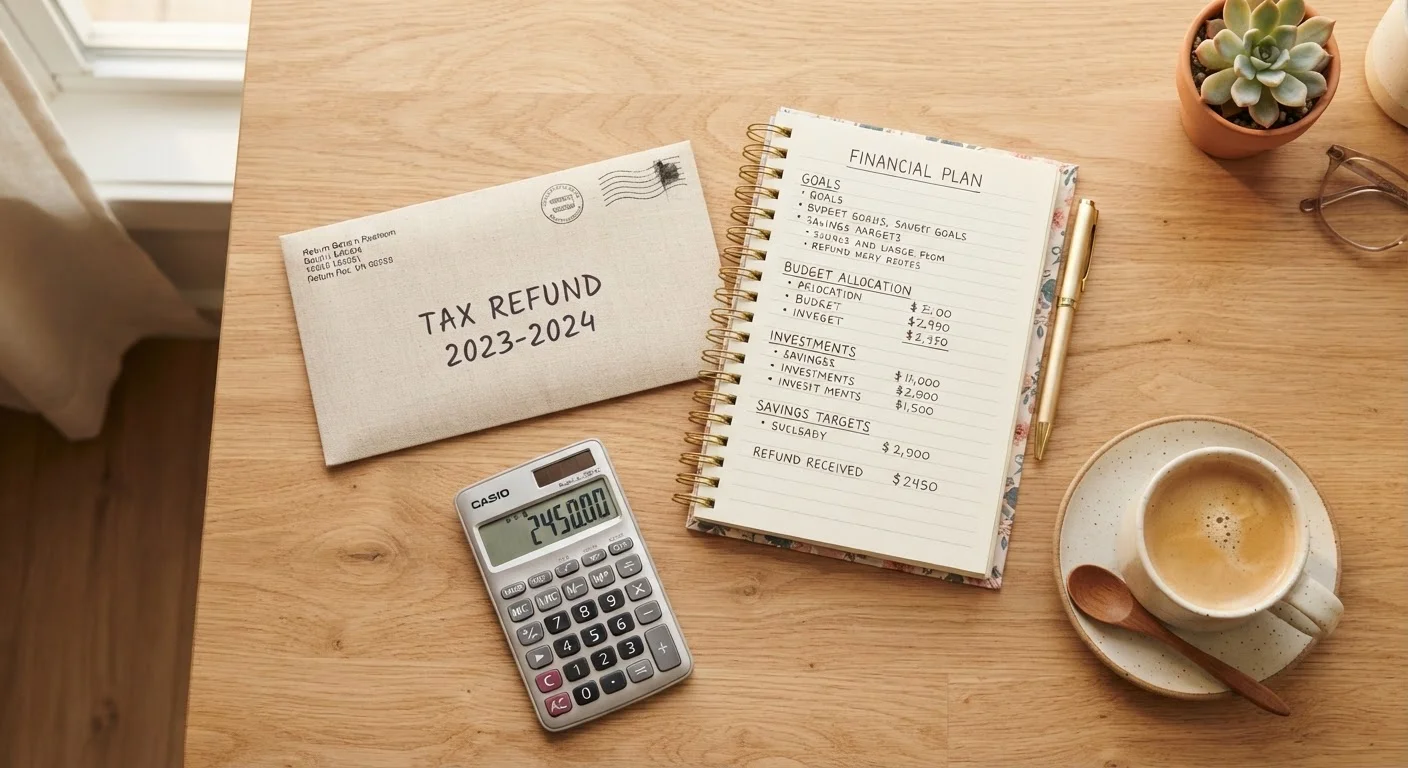
Before you plan how to use a refund, it helps to understand what it represents. A federal tax refund means you had more withheld from your paychecks during the year than you actually owed in taxes. In other words, you gave the government an interest-free loan — and now you're getting it back.
This framing matters because it changes how you should feel about the money. It isn't a bonus or a gift. It's your own earnings, returned late. If you consistently receive large refunds, it may be worth adjusting your W-4 withholding so that money stays in your paycheck throughout the year instead — where you can put it to work sooner. A tax professional can help you think through the right withholding level for your situation.
A tax refund is your own money returned — not a bonus from the government.
Pay off high-interest debt first
If you're carrying credit card balances or other high-interest debt, paying it down is almost always the highest guaranteed "return" available to you. If a credit card charges 22% APR and you pay it off, you've effectively earned a 22% return on that money — risk-free and immediate. No investment reliably matches that.
The math is straightforward: interest on consumer debt compounds against you. Every month you carry a balance, you owe more. Using a windfall to eliminate or significantly reduce that balance stops the bleeding immediately. For a deeper look at balancing debt payoff against saving goals simultaneously, see our guide on prioritizing debt and savings.
Paying off 22% APR debt is a guaranteed 22% return — no investment reliably beats that.
Build or bolster your emergency fund
An emergency fund is the foundation of financial stability. The general guideline — commonly cited by financial educators — is to work toward three to six months of essential living expenses held in a liquid, accessible account. If you don't have that cushion yet, a windfall is one of the fastest ways to close that gap.
Why does this come before investing? Because without a safety net, any unexpected expense — a car repair, a medical bill, a job disruption — forces you back into high-interest debt. The emergency fund is what keeps a single bad month from becoming a financial setback that takes years to reverse. Even moving from zero to one month of expenses saved meaningfully reduces your vulnerability.
Without an emergency fund, one bad month can undo years of financial progress.
Fund a sinking fund for known future expenses
Once urgent debt is addressed and your emergency baseline is covered, consider directing a portion of your windfall toward predictable future costs that tend to arrive as surprises: car registration, holiday gifts, annual insurance premiums, home repairs. These aren't emergencies — they're expenses you can see coming, and setting aside money for them now prevents them from derailing your budget later.
This approach is sometimes called a sinking fund: a dedicated pool of money earmarked for a specific upcoming cost. It's one of the most underused but practical budgeting tools available. Learn how sinking funds work and how to set one up without overcomplicating it.
Sinking funds turn predictable future expenses into manageable, planned-for line items.
Invest what's left — time is the multiplier
After high-interest debt, emergency savings, and near-term costs are covered, any remaining windfall has the potential to grow through investing. Even a few hundred dollars invested in a tax-advantaged account — such as an IRA or a 401(k) if your employer allows additional contributions — can compound meaningfully over decades.
The key concept here is compound growth: the idea that returns generate their own returns over time. Starting even a small amount earlier rather than later can make a significant difference over a long horizon. You can explore this concept in more depth in our explainer on compound interest. Note that all investing involves risk, including the possible loss of principal, and past performance does not guarantee future results. Consider speaking with a licensed financial adviser before making investment decisions.
Time is the most powerful variable in investing — starting earlier matters more than starting bigger.
Allow yourself a small, guilt-free spending portion
A plan that's 100% discipline and 0% enjoyment tends not to last. If every windfall is immediately routed to obligations with nothing left over, the system can start to feel punishing — and that feeling often leads to abandoning the plan entirely next time.
A practical approach many financial educators suggest is to reserve a modest, pre-decided percentage of any windfall for guilt-free spending — something like 10%. If your refund is $2,000, that's $200 for whatever you genuinely want, while the remaining $1,800 goes to work. The key is that you decide the amount before the money arrives, not after. A framework like the 50/30/20 rule can help you think about proportions across your finances more broadly.
Pre-deciding your fun money amount keeps the plan sustainable without derailing your goals.
Making It Stick
The single biggest threat to a good plan is complexity. If your system has twelve steps and requires a spreadsheet to manage, it probably won't survive contact with real life. Keep it simple: write down the dollar amounts you're assigning to each priority before you move the money, then act on that plan within a week while your motivation is still high.
One practical approach is to split the lump sum into separate accounts on the day it arrives — one for debt, one for savings, one for your allowed discretionary amount. Physical separation reduces the temptation to treat the whole pool as spendable. Many online banks allow you to create labeled sub-accounts at no cost, which makes this easy.
Act Within a Week
The longer a windfall sits in your checking account undirected, the more likely it is to quietly disappear into everyday spending. Once you've decided on your allocation, move the money within seven days. Transfer the debt payment, fund the savings account, and separate the discretionary portion — don't let it pool together where it's hard to track.
Finally, a windfall is a snapshot, not a strategy. The habits you build around a regular paycheck matter far more over time. If you haven't yet mapped out where your income goes month to month, the spending categories explainer is a good place to start.