

Key Takeaways
Compound Interest
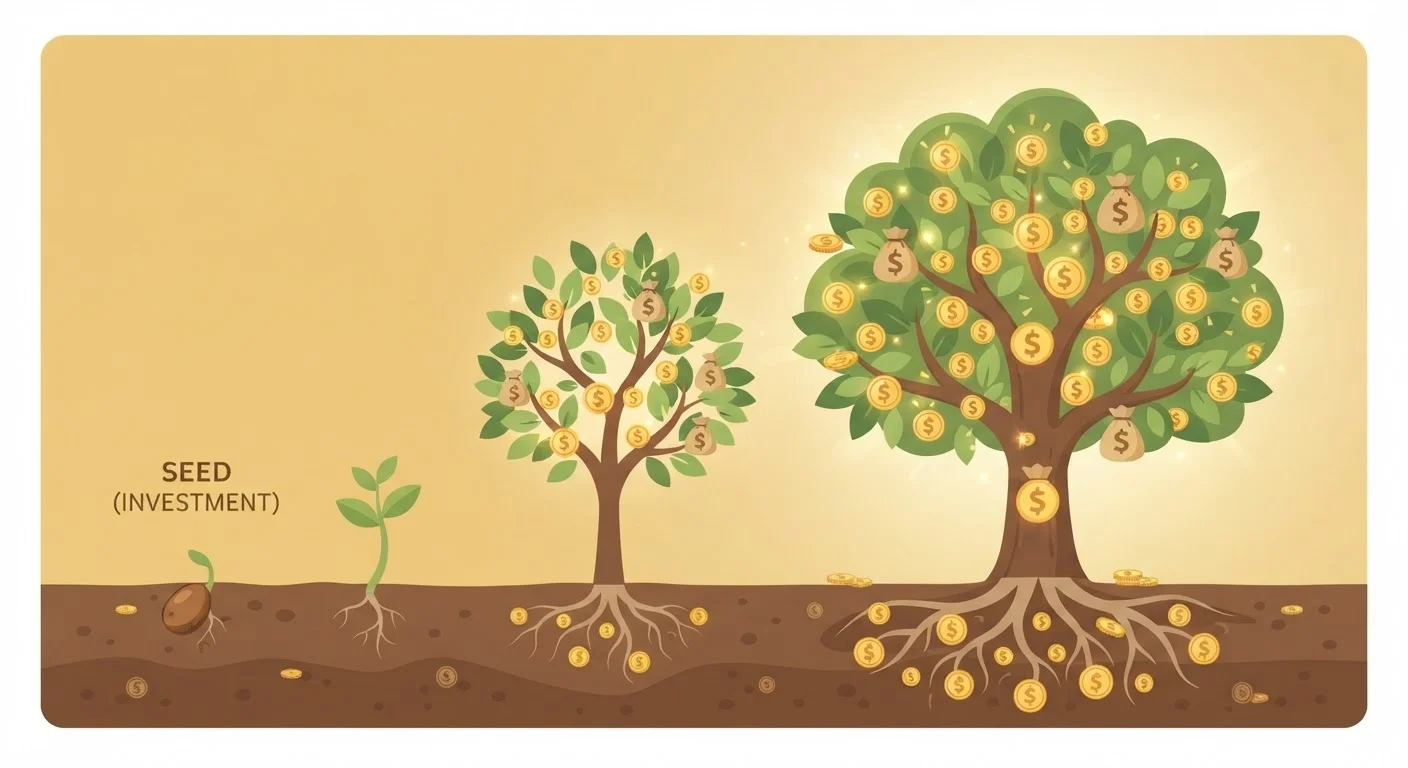
Compound interest is the process of earning interest not just on your original deposit or investment, but also on the interest you've already earned. In other words, your earnings generate their own earnings over time. This cycle repeats — often monthly or annually — causing your money to grow faster the longer it sits.
Mathematically, compound interest is expressed as A = P(1 + r/n)^(nt), where P is the principal, r is the annual interest rate, n is the number of compounding periods per year, and t is time in years. More frequent compounding periods (daily vs. annually) produce slightly higher returns.
Why 'Interest on Interest' Changes Everything
Most people understand that saving money in an account earns interest. What feels less intuitive is that those interest earnings themselves begin earning returns — and that cycle is what makes compound interest so powerful.
Imagine you deposit $1,000 into an account earning 5% annually. After year one, you have $1,050. In year two, you earn 5% on $1,050 — not just on your original $1,000. That extra $2.50 sounds trivial, but stretch this out over 30 years and the gap between compound and simple interest becomes significant. The same $1,000 growing at 5% compounded annually reaches roughly $4,320 after 30 years. With simple interest, it would reach only $2,500.
The math isn't magic — it's just time doing what it does when you let it work uninterrupted.
$4,320
Value of $1,000 after 30 years at 5% compounded annually
Compared to $2,500 with simple interest at the same rate — illustrating how compounding accelerates growth over time.
Rule of 72
Years to double money: divide 72 by your interest rate
At a 6% annual return, money roughly doubles in 12 years — a widely used mental shortcut in personal finance education.
10 years
Early start advantage that can rival 30 years of later contributions
Illustrative scenarios consistently show that an investor who starts a decade earlier but contributes less total can finish with a comparable balance, due solely to compounding time.
The Role of Time: Why Starting Early Matters So Much
Of all the variables in the compounding equation, time is the one that separates good outcomes from transformative ones. Consider two people: one begins investing $200 per month at age 25 and stops at 35 (10 years of contributions). The other starts at 35 and invests $200 per month all the way to age 65 (30 years of contributions). Assuming a 7% average annual return, the early starter — despite contributing far less money — often ends up with a comparable or larger balance than the late starter, purely because of the extra decades of compounding.
This isn't an argument for obsessing over a few missed months. But it is a strong case for beginning as early as you reasonably can — even with modest amounts — rather than waiting until circumstances feel perfect. As a general financial principle, time invested is often more valuable than dollars invested later.
For more on how to get started without waiting for the "right" moment, see common investing myths debunked.
Start Small — Just Start
You don't need hundreds of dollars a month to benefit from compounding. Even $25 or $50 invested consistently in a retirement or brokerage account begins the compounding clock. The most important decision is getting started, not getting the amount perfect.
Where Compound Growth Actually Happens
Compound interest doesn't only live in savings accounts. It shows up — in different forms — across most long-term financial vehicles:
- High-yield savings accounts and CDs: Traditional interest-bearing accounts with defined compounding schedules. Rates are modest but predictable.
- Retirement accounts (401(k), IRA): Investments inside these accounts grow on a compounding basis — not from a fixed interest rate, but from reinvested gains, dividends, and price appreciation over time.
- Brokerage accounts: Reinvesting dividends rather than withdrawing them puts compound growth to work on stock portfolios.
The flip side: compounding also applies to debt. Credit card balances, for instance, compound monthly on unpaid balances. A $3,000 balance at 20% APR can quietly balloon if only minimum payments are made. Understanding this dynamic is just as important as understanding how it builds wealth. If you're weighing saving against paying down debt, this guide to prioritizing saving versus debt payoff walks through how to think it through.
Practical Habits That Let Compounding Do Its Work
Compound interest is a passive force — it works in the background as long as you don't interrupt it. A few habits protect and amplify it:
- Reinvest returns automatically. Don't withdraw dividends or interest earnings — let them stay invested so they can compound.
- Contribute consistently. Regular contributions, even small ones, add new principal that begins compounding immediately.
- Minimize high-interest debt. Paying down debt with double-digit interest rates is often the highest guaranteed "return" available to you, since those rates compound against you. Explore saving and debt basics for practical starting points.
- Avoid unnecessary withdrawals. Pulling money out resets the clock on that portion of your balance and breaks the compounding chain.
Building long-term financial stability isn't about finding a clever trick — it's about giving consistent, patient behavior time to compound. See principles for building a long-term investment mindset for guidance on staying the course.
This article is for general informational and educational purposes only and does not constitute personalized financial or investment advice. Please consult a qualified financial professional for guidance specific to your situation.