

Key Takeaways
Our Verdict
There is no universally superior method — each approach has legitimate strengths that suit different people and circumstances. Bodyweight training wins on accessibility, free weights excel for progressive overload and functional carry-over, and machines offer guided safety that many beginners and rehabilitating individuals genuinely need.
| Best for | Recommended |
|---|---|
| Those with limited space, budget, or equipment access | Bodyweight Training |
| People focused on building overall strength and athletic performance | Free Weights |
| Beginners learning movement patterns or those recovering from injury | Machines |
| Most everyday Americans seeking long-term fitness habits | A mix of all three |
What Resistance Training Actually Does
Resistance training — any exercise where your muscles work against an opposing force — is one of the most well-supported strategies for maintaining muscle mass, bone density, metabolic health, and functional strength as you age. The American College of Sports Medicine recommends that most adults include muscle-strengthening activity at least two days per week.
The good news: that force can come from your own body, from dumbbells and barbells, or from a weight machine. Each method creates the stimulus your muscles need to adapt and grow stronger. The differences lie in how accessible, versatile, and technically demanding each approach is — and that's where your situation starts to matter. If you're still figuring out how to fit any of this into a packed week, our guide to building a weekly exercise routine offers a practical starting framework.
Bodyweight Training: The Case for Using What You Have
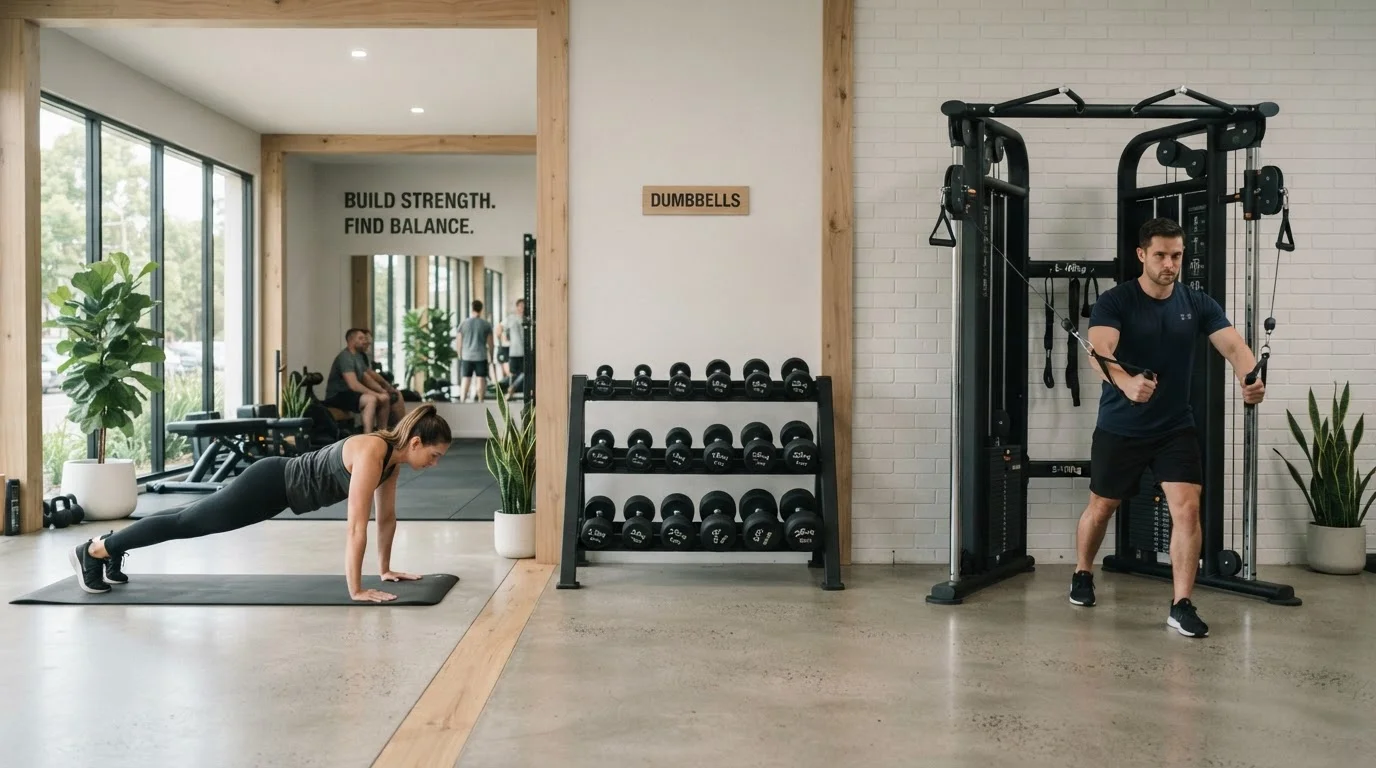
Bodyweight exercises — push-ups, squats, lunges, planks, pull-ups — require no equipment and no gym membership. That alone makes them one of the most sustainable long-term options for everyday Americans.
Beyond convenience, bodyweight movements often engage multiple muscle groups and challenge your balance and coordination simultaneously. A single-leg squat, for example, builds leg strength while demanding core stability — something a leg-press machine doesn't replicate in the same way.
The main limitation is progressive overload — the principle of gradually increasing challenge to keep driving adaptation. With weights, you simply add a plate. With your body, you have to get more creative: slowing the movement down, elevating your feet, or progressing to harder variations. It's entirely doable, but it requires more planning at advanced levels.
Start Simple and Build From There
If you're new to resistance training, mastering a handful of foundational bodyweight movements — a solid squat, push-up, and hinge — before adding external load will serve you far better than jumping straight to heavy weights. Good movement patterns are the foundation everything else is built on. Once the basics feel natural, adding resistance becomes much safer and more effective.
Free Weights: Versatile, Effective, and Worth the Learning Curve
Dumbbells, barbells, and kettlebells are popular for good reason. They allow a wide range of exercises, adapt easily to any strength level, and require your stabilizing muscles to work alongside the primary movers — which has real-world carry-over to everyday activities like carrying groceries or lifting children.
Research consistently supports free weight training for building strength and muscle. A well-designed program using progressive overload — gradually adding weight over time — is one of the most reliable ways to make measurable gains.
The honest trade-off is technique. Poor form with a barbell can put unnecessary stress on joints and the spine. If you're new to free weights, a few sessions with a qualified personal trainer or certified strength coach can make a significant difference in both safety and results.
| Bodyweight | Free Weights | Machines | |
|---|---|---|---|
| Cost | Free | Low to moderate | High (gym or home) |
| Space required | Minimal | Small-to-moderate | Significant |
| Beginner-friendliness | High | Moderate | High |
| Progressive overload ease | Requires creativity | Very straightforward | Straightforward |
| Stabilizer muscle engagement | High | High | Low |
| Injury risk with poor form | Low to moderate | Moderate | Lower |
| Portability | Complete | Moderate | None |
Machines: Structure, Safety, and a Lower Learning Curve
Weight machines guide your movement along a fixed path, which reduces the coordination demands and lowers the risk of using sloppy form under fatigue. For someone just starting out, returning after time off, or working around a specific injury, that structure is genuinely valuable — not a shortcut.
Machines also make it easy to isolate individual muscles (think: the leg curl for hamstrings or the chest fly for pectorals), which can be useful for rehabilitation or addressing specific muscle imbalances.
The limitation is that fixed movement paths don't always match your body's natural mechanics, and machines typically don't challenge your stabilizer muscles the way free weights or bodyweight movements do. They're also the least portable option — you need gym access or a significant home investment.
It's worth noting that resistance training of any kind is quite different from simply staying active throughout the day. Our article on daily movement vs. structured exercise explores how the two contribute differently to long-term well-being.
How to Choose — and When to Combine
Think about three things: your current experience level, your available space and budget, and your specific goals.
- Beginners often do well starting with machines or bodyweight movements to learn basic patterns before adding free weights.
- People training at home with limited space will naturally lean on bodyweight work, possibly supplemented by a set of adjustable dumbbells.
- Those focused on strength gains tend to get the most from free weights over time, given the flexibility for progressive overload.
- Anyone recovering from injury should consult a physical therapist or physician before choosing a method — each carries different demands and risks depending on the injury.
In practice, many people find that combining approaches produces the best results and keeps training interesting. A workout might open with a barbell compound lift, include machine isolation work, and finish with a bodyweight core circuit. There's no rule that says you must pick one lane and stay in it.
This article is for general informational purposes only and does not constitute medical or professional fitness advice. Always consult a qualified healthcare provider or certified fitness professional before beginning a new exercise program, especially if you have any existing health conditions or injuries.