

Key Takeaways
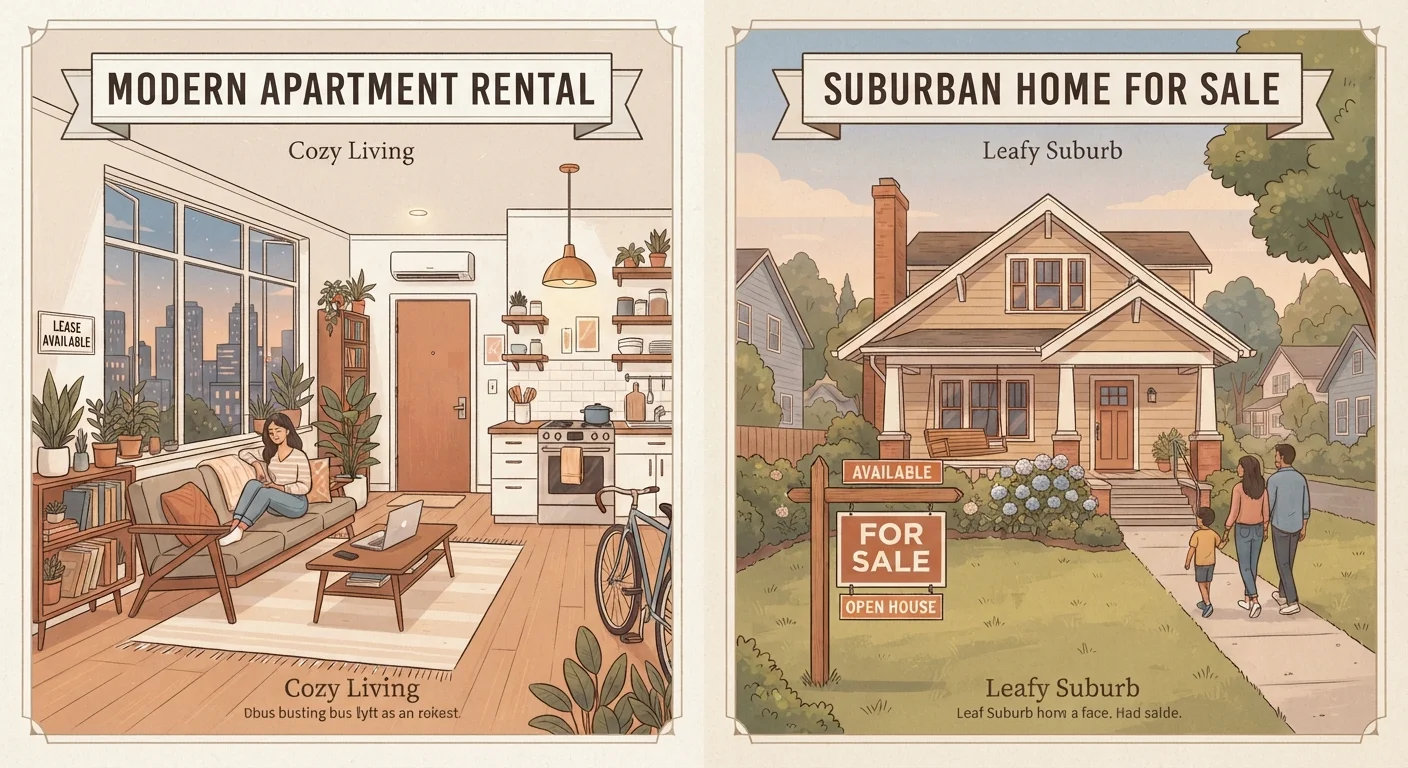
Option A
Renting
The flexible, lower-commitment path to housing.
Best for: People who value mobility, want predictable monthly costs, or aren't yet ready for the financial responsibility of ownership.
Option B
Owning
The long-term wealth-building option with more complexity.
Best for: People who plan to stay in one place for several years and can absorb the upfront costs and ongoing responsibilities of homeownership.
If you plan to move within the next three to five years
Renting
Buying and selling a home within a short window rarely recovers closing costs and transaction fees. Renting preserves flexibility without the financial penalty of a quick resale.
If you have a stable income, a solid emergency fund, and plan to stay long-term
Owning
Over a decade or more, equity buildup and fixed mortgage payments can make ownership financially advantageous compared to rising rents — provided you've accounted for maintenance costs.
If you're carrying significant high-interest debt or lack a down payment
Renting
Taking on a mortgage before stabilizing your financial foundation can put both your housing and broader finances at risk. Strengthening savings first is generally the prudent path.
If you want to invest the difference between renting and ownership costs
Renting
In some markets, renting is meaningfully cheaper month-to-month. Consistently investing the savings can produce comparable or even stronger wealth outcomes — though this requires real discipline.
If building home equity and housing stability are your primary goals
Owning
Homeownership has historically been a primary wealth-building vehicle for American households. Fixed-rate mortgages also provide payment predictability that rent increases cannot match.
The Myth That Renting Is Always a Waste
Few phrases in personal finance are more misleading than the idea that renters are "throwing money away." When you rent, you're exchanging money for a real service: a place to live, without the financial exposure that comes with ownership. The same logic would suggest that paying for car insurance or groceries is wasted money — it isn't.
What homeownership does offer is equity accumulation: as you pay down a mortgage, you gradually own more of a real asset. But that asset comes with costs that aren't always visible in the monthly mortgage payment. Interest, property taxes, homeowner's insurance, maintenance, and the opportunity cost of a down payment all shape the real financial picture.
Understanding the comparison honestly means looking at both sides without the cultural weight that often tips the scales.
What Renting Actually Costs (and Provides)
A monthly rent payment covers your housing for that month — and typically not much more. In most cases, renters are not responsible for major repairs, property taxes, or structural maintenance. That predictability is genuinely valuable, especially for households managing tight budgets.
Renters do, however, face real financial risks: rent increases at lease renewal, limited ability to modify their living space, and no equity accumulation from monthly payments. Over time, in many U.S. markets, rents have risen faster than inflation, which can erode the affordability advantage renting may offer earlier in life.
That said, renting also frees up capital. A down payment on a median-priced U.S. home can run from tens of thousands to well over a hundred thousand dollars depending on location. Those funds, if rented instead and invested with discipline, could grow in other ways — though investment returns are never guaranteed. For a broader look at how to think about this, the Investing 101 hub covers foundational concepts worth understanding.
| Criterion | Renting | Owning |
|---|---|---|
| Monthly payment predictability | Fixed for lease term; can rise at renewal | Fixed-rate mortgage is stable; taxes/insurance can rise |
| Upfront costs | First/last month, security deposit | Down payment plus closing costs (often 6–10% of price) |
| Equity accumulation | None from payments | Builds over time, slowly at first |
| Maintenance responsibility | Generally landlord's burden | Entirely owner's responsibility |
| Flexibility to relocate | High — move at lease end | Low — selling takes time and money |
| Tax considerations | No property tax; no mortgage interest deduction | Property taxes due; mortgage interest may be deductible |
| Exposure to market value changes | None | Home value can rise or fall |
What Owning Actually Costs (and Provides)
Mortgage principal and interest are just the beginning. Homeowners typically budget for property taxes (which vary widely by state and municipality), homeowner's insurance, HOA fees where applicable, and ongoing maintenance. A commonly cited rule of thumb suggests budgeting roughly 1% of a home's value annually for maintenance — though actual costs vary significantly by home age, condition, and location.
Closing costs when buying and selling — often totaling 6% to 10% of the home's price — mean that short-term ownership rarely pays off financially. The equity argument strengthens considerably the longer you stay in a home.
There's also the matter of interest. In the early years of a standard 30-year mortgage, the majority of each payment goes toward interest rather than principal. Equity builds slowly at first, then more quickly as the loan matures.
For a practical look at how to plan for ongoing home expenses, see how household budgeting for home expenses actually works. And if you're navigating this decision as part of a shared financial life, budgeting as a couple is worth reading alongside this one.
~1%
Annual home maintenance rule of thumb
Many financial planners suggest budgeting approximately 1% of a home's purchase price per year for maintenance, though actual costs vary by home age and condition.
6–10%
Typical total transaction costs when buying and selling
Combined buyer closing costs and seller agent commissions frequently total 6–10% of the home's sale price, weighing against short-term ownership.
5+ years
Commonly cited break-even horizon for buying
Many financial analyses suggest homeowners typically need to stay at least five years to recoup upfront purchase costs through equity buildup — though this varies by market.
How to Think About the Comparison Honestly
The financial outcome of renting versus owning depends on factors that differ by household: local home prices, rent levels, how long you stay, your mortgage interest rate, how well the local housing market appreciates, and what you do with any money you save by renting. No universal answer applies to everyone.
A few questions tend to clarify the decision:
- How long do you plan to stay? Conventional financial guidance often suggests that owning begins to make stronger financial sense after five or more years in the same home, once upfront costs are absorbed.
- What are your local market conditions? In some cities, buying is relatively affordable compared to renting. In others — particularly high-cost metro areas — renting can be the financially sounder option indefinitely.
- What is your financial foundation? A mortgage is a long-term, large-scale debt obligation. Taking it on before building an emergency fund and addressing high-interest debt carries real risk. The Saving & Debt hub offers guidance on getting that foundation solid.
- What does ownership cost in your target area beyond the mortgage? Property tax rates, insurance costs, and maintenance demands vary enormously by region and home type.
This article is for general informational and educational purposes only and does not constitute financial or legal advice. Housing and investment decisions are personal and complex — speak with a licensed financial adviser before making decisions based on your specific circumstances.